











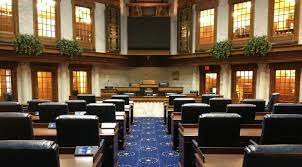
The Indiana Senate passed SB 27 on a decisive 45–4 vote, advancing legislation designed to bring the Chicago Bears to Hammond. On its face, the bill is a regional economic development package. It creates the Northwest Indiana Stadium Authority, authorizes Lake and Porter counties to adopt a 1% food and beverage tax, permits increases in local innkeeper taxes, establishes a Hammond admissions tax, and empowers the new authority to issue long-term bonds — up to forty years — backed by those revenue streams.
Supporters called it jobs. Growth. Regional momentum. A bold economic play for Northwest Indiana. And judging by the vote margin, most senators were comfortable signing on.
But legislation often contains more than its headline.
SB 27 amends Indiana Code 5-1.2-2-62 to expand the list of “referenced statutes” governing the Indiana Finance Authority to include IC 5-1-17, IC 5-1-17.1, IC 5-1-17.5, IC 5-1.3, and multiple transportation-related chapters, including IC 8-9.5, IC 8-14.5, IC 8-15, IC 8-15.5, and IC 8-16. The bill also authorizes the authority to issue bonds and acquire obligations under IC 5-1-17 and IC 5-1-17.1 — statutory frameworks used for major capital and infrastructure financing statewide.
That is not just stadium language. That is embedding the stadium authority inside the broader statewide infrastructure finance ecosystem. And then there is the $250 million trigger.
SB 27 requires that any Indiana Department of Transportation project estimated to cost at least $250 million in a single county must be reviewed by the State Budget Committee before contract letting. It did not dominate debate. It did not headline press releases. But it matters.
To understand why, you have to leave Hammond. Drive roughly 240 miles south — past Indianapolis, past Bloomington — down to Jasper and Dubois County. That is where the Mid-States Corridor runs. Governor Mike Braun’s marquee transportation initiative. A project that has generated organized resistance from landowners, skepticism from fiscal conservatives, and unease among local officials. A project whose projected cost easily exceeds the $250 million threshold now tied to mandatory legislative review.
Yet during debate on SB 27, no one mentioned the Mid-States Corridor. Not once. The Senate discussion stayed focused on Hammond. On food and beverage taxes. On bond maturities. On the NFL. Meanwhile, the bill quietly adjusted the oversight structure governing mega-project transportation spending.
Requiring budget committee review does not kill a project. It does not halt construction. But in the Indiana Statehouse, review authority is leverage. And leverage is rarely accidental. By embedding the stadium authority within the same statutory framework used for large-scale infrastructure financing — and by inserting a $250 million review threshold for INDOT projects — lawmakers have reinforced their institutional role in overseeing projects of the Mid-States scale.
While no one will admit it publicly, the message to the second floor is hard to miss: if you want your corridor, it runs through us.
There is also political reality. Governor Braun is not going to veto a Bears stadium bill that passed 45–4. He is not going to torpedo a high-profile economic development win for Northwest Indiana over a provision that increases legislative oversight of major road projects. That would be a losing fight.
So SB 27 moves forward. The headline is a stadium in Hammond. The subtext is structural authority over statewide infrastructure financing. Hammond may be the economic development story. Jasper may be the power story. When a Northwest Indiana sports bill quietly tightens the Legislature’s grip on $250 million transportation projects — and no one says “Mid-States Corridor” out loud — that silence carries weight.
In Indiana politics, the most consequential moves are not always the ones debated at length on the floor. Often, they are the ones that travel with the vote.
See you all at the next State Budget Committee hearing.