











by Abdul-Hakim Shabazz
If you’ve spent any time around Indiana local government lately, you’ve heard some version of this sentence delivered with the weary tone of a person staring into the fiscal abyss:
“We can’t raise taxes… but we also can’t cut any more… but we also have to keep doing everything.”
That’s not a budget strategy. That’s a prayer circle.
Property tax reform—plus the politics that come with any sentence containing the words “property” and “tax”—has communities in a squeeze. Cities, towns, townships, schools, libraries, and public safety agencies are all being told, in effect: do the same job with less money and smile while you do it. Meanwhile, Hoosiers are saying (loudly, and with feeling), “I don’t want to pay more.”
Okay. Fair. No one wakes up and says, “You know what would really make today sparkle? A bigger tax bill.”
But here’s the part everyone conveniently skips: if you don’t want to pay more, and you don’t want services to get worse, then somebody has to add value to the system. Not vibes. Not slogans. Actual taxable value.
Which brings us to the most unromantic economic development hero imaginable: the data center.
Yes, I said data center. A windowless building full of servers that looks like a high-security Costco for computers. No, it won’t make a great postcard. But from the standpoint of the property tax base—especially in a post-reform Indiana—data centers are the kind of thing local officials dream about when they’re staring at a spreadsheet at 2 a.m. wondering which sacred cow is about to become hamburger.
Here’s the basic math, minus the government-speak: local governments don’t want to crank up tax rates. What they need is enough assessed value in the community so the rate can stay reasonable while still generating the revenue required to keep things running. When your tax base is thin, every new need gets piled onto the same backs—usually homeowners and small businesses. When your tax base grows, the burden spreads out.
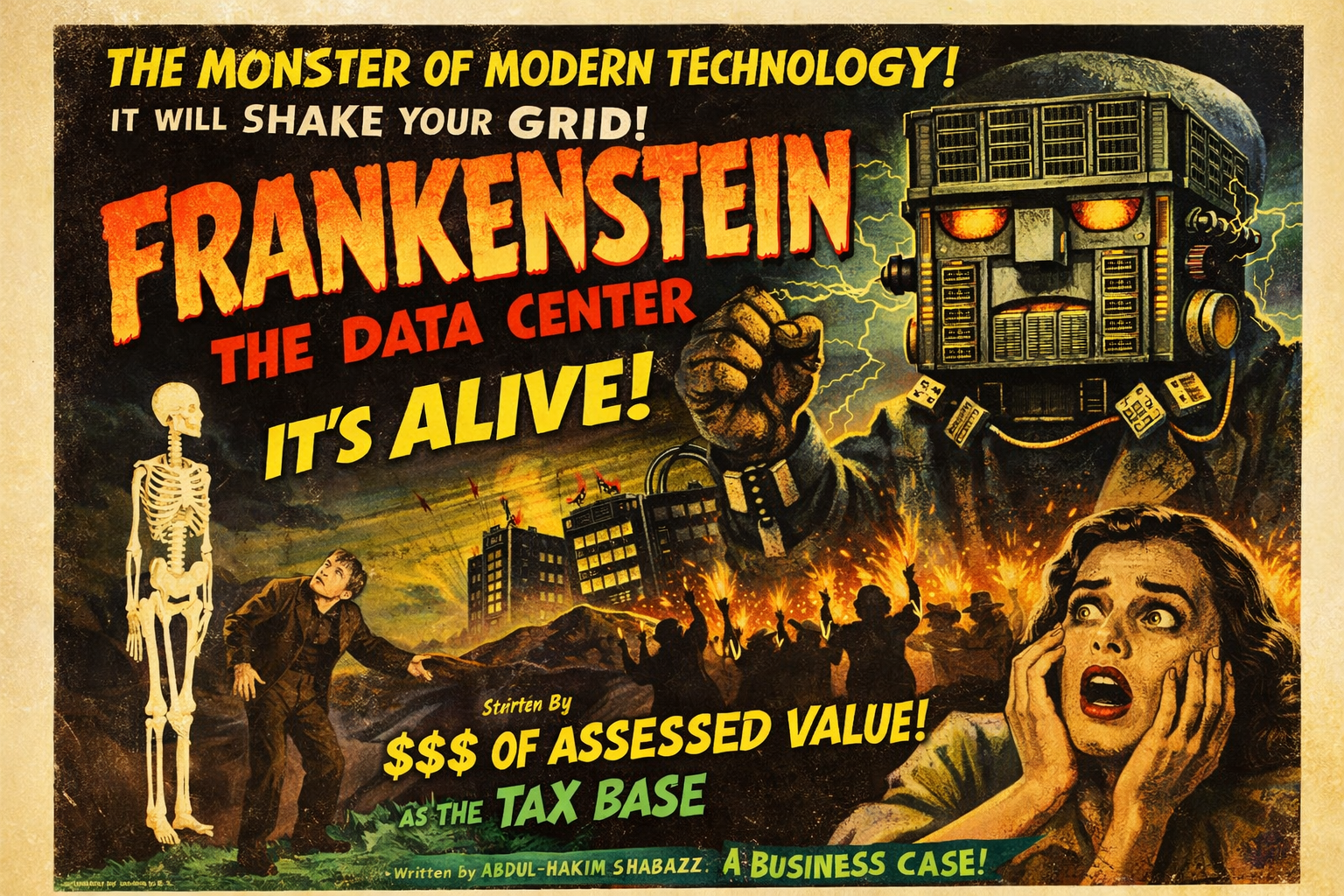
And this is where the Frankenstein metaphor shows up, because every data center proposal in Indiana seems to trigger the same scene: villagers storming the castle with torches and pitchforks, shouting that the monster is coming.
Here’s my take: data centers don’t bother me as long as we use a normal brain. And yes, that line is doing work—because in the Frankenstein universe, Igor grabbed the wrong jar and walked off with the abnormal brain instead of the normal one. That’s how you end up with a monster, a mob, and an insurance claim.
This isn’t witchcraft. It’s infrastructure. Your phone data has to go somewhere. The “cloud” is not magic floating above Hamilton County—it’s buildings with servers in them. On land. With power. We can argue about where to put them and how to regulate them, but we cannot pretend we’re living in a world where data doesn’t exist.
For the anti-tax crowd, this should be the moment you lean in. Because if you’re serious—truly serious—about keeping property taxes from creeping up on homeowners, you need more taxable value in the system. Otherwise “tax relief” becomes a magic trick where the money disappears, and then we all stand around acting confused when response times get slower, roads get rougher, and everyone’s mad at the same county council they begged to “hold the line.”
And here’s something else local officials understand even if they don’t put it on a campaign mailer: a stronger tax base can mitigate pressure for local income tax increases. When property tax options get squeezed and costs keep rising, local governments don’t have infinite levers. A big commercial ratable doesn’t solve everything, but it can keep “raise the income tax” from becoming the default answer every budget season.
Now, before we start throwing confetti and naming our next Little League team “The Hyperscales,” let’s be honest about the tradeoffs.
Data centers bring real infrastructure demands—power, water, transmission capacity. They can require expensive upgrades. They can create legitimate land-use concerns, noise issues (hello, generator testing), and the kind of “what exactly is this thing doing here?” anxiety that grows in any community that’s been burned before. And yes, the jobs-per-acre number is never going to wow anybody. A data center isn’t a car plant. Nobody has ever claimed otherwise, and opponents have been correctly pointing that out since the first server rack was bolted to the floor.
Then there’s the big one: incentives.
If your local officials give away the store in abatements and special deals, you can end up with a shiny new facility that looks fantastic in a press release but doesn’t deliver the tax-base punch you were promised—at least not for years. That’s not an argument against data centers. That’s an argument against negotiating like you’re buying a used couch off Facebook Marketplace.
Which brings me to one of the most Indiana moments in this entire debate. At an Indianapolis City-County Council meeting tied to that Franklin Township data center proposal—the one that ultimately got withdrawn—the woman leading the opposition read a statement from her cell phone.
I’m not mad at her for using a phone. I’m mad at the irony for being so aggressive.
Because where do you think that statement was stored? Where do you think her phone pulled it from? That’s right: the cloud. And where does the cloud live? In servers. In buildings. In—say it with me—data centers.
That doesn’t make her concerns illegitimate. It does highlight the inconsistency: we all want the benefits of an always-on, data-driven world, but some folks want the infrastructure to exist… just not anywhere they can see it.
So here’s what “normal brain” policy looks like:
-
Transparency. If you’re telling the public “this helps our tax base,” show the numbers and the timeline in plain English. Not 47 pages of PDF fog.
-
Net benefit. If the community is paying for major infrastructure upgrades, the agreement should reflect that. “Trust us” is not a fiscal plan.
-
Guardrails. Noise limits and testing windows. Buffering. Stormwater. Lighting. Enforceable conditions—not vibes.
-
Planning. Power and water shouldn’t be afterthoughts. If we’re going to attract big energy users, we should also act like we’ve met an electric grid before.
At the end of the day, Indiana has a choice. We can keep pretending we can fund communities with wishful thinking and bumper stickers, or we can pursue development that expands the base without turning homeowners into permanent fiscal hostages.
Data centers aren’t glamorous. Nobody’s taking engagement photos in front of Server Rack Row 12. But if your priority is protecting Hoosiers who don’t want to pay more taxes while keeping communities functional, assessed value isn’t the villain. It’s the lifeboat.
And if we do this with a normal brain—clear rules, real numbers, enforceable protections—then we don’t end with a mob scene. We end like Young Frankenstein: somebody flips the switch, the thing jolts to life—“It’s alive! It’s alive!”—and instead of torches and panic, the monster is out there… Puttin’ on the Ritz.
Abdul-Hakim Shabazz is the publisher of Indy Politics and an attorney licensed in Indiana and Illinois.