









Senate Bill 27 has been sold as a stadium bill. And largely, it is. The legislation creates the Northwest Indiana Stadium Authority, authorizes bonding mechanisms, and restructures tax streams in Lake and Porter counties to support a potential professional sports facility in Hammond. It is big, ambitious, and economically framed.
But buried inside the bill is language that could have consequences far beyond Northwest Indiana — particularly for the future of the Mid-States Corridor.
As first reported by WFYI and the Indiana Capital Chronicle, SB 27 requires that before the Indiana Department of Transportation submits any project costing $250 million or more in a single county to federal authorities, the project must first be reviewed by the State Budget Committee. That may sound procedural. It is not.
For years, INDOT’s largest projects have moved through an executive-driven process: environmental review, engineering refinement, federal coordination, and eventual contract letting. The Legislature sets funding parameters but has not historically inserted itself into project-level review prior to federal submission.
SB 27 changes that.
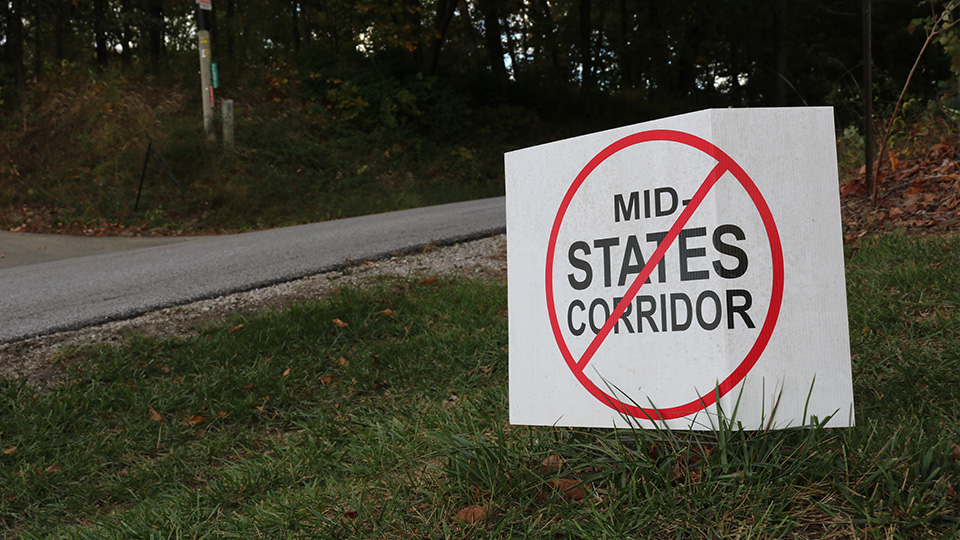
And few projects loom larger than the Mid-States Corridor — the proposed 54-mile highway linking Interstate-64 to Interstate-69 through southern Indiana. In Dubois County alone, where approximately 23 miles of the route would run, cost projections exceed $1 billion. Even phased construction could easily surpass the $250 million single-county trigger embedded in SB 27.
That means Corridor segments would now face mandatory legislative review before advancing federally.
This does not kill the project. The Budget Committee does not gain formal veto authority. The Governor does not lose executive control over INDOT.
But it creates a public checkpoint. And public checkpoints alter political terrain.
That shift comes at a moment when local sentiment in Corridor territory is anything but ambiguous. A December Public Policy Polling survey of 636 registered voters in Dubois County delivered overwhelming opposition: 81 percent oppose the Mid-States Corridor, with 72 percent strongly opposed and just 14 percent supportive. Even more politically significant, 77 percent said they would be less likely to vote for a local official who supports the project, and 87 percent said elected officials should clearly state their position.
In Jasper and surrounding communities — the very ground zero of the route — resistance is not marginal. It is decisive.
The Mid-States Corridor has long been viewed as a gubernatorial priority, a signature infrastructure initiative advanced under the banner of economic development and freight mobility. In political terms, it is not merely a road project; it is an executive branch project.
That context matters when examining where the oversight language lives.
It was not filed as a standalone transportation reform bill. It was attached to a stadium financing measure that enjoys broad bipartisan backing and carries substantial economic development weight. Given the scale and support behind SB 27, it is, for practical purposes, veto-proof. Removing the oversight provision would risk unraveling a much larger legislative package.
That is not accidental positioning.
By embedding mandatory Budget Committee review inside a politically powerful bill, the Legislature has created a structural checkpoint that the executive branch cannot easily sidestep. The Governor retains authority. INDOT retains operational control. But large segments of the Corridor must now pass through a legislative spotlight before federal submission.
SB 27 is up Thursday morning for concurrence, meaning the Senate will decide whether to accept the House amendments — including the oversight provision — before sending it to the Governor’s desk.
Budget Committee review means hearings. It means cost projections scrutinized on the record. It means lawmakers — not agency officials — shaping the public conversation about farmland impact, right-of-way acquisition, freight assumptions, and long-term maintenance liabilities.
That is more than transparency.
It is institutional leverage.
And when executive ambition meets overwhelming local opposition, leverage becomes the Legislature’s quiet way of applying the brakes — without ever formally saying “stop.”