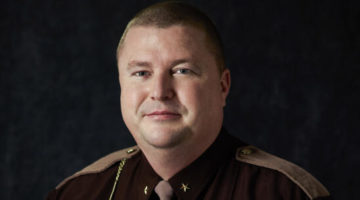








Some will say it’s anti-Catholic. Others will say it’s simply commentary about the direction of the conservative movement. Either way, Indiana Lt. Gov. Micah Beckwith has inserted himself into the debate and is now part of the conversation.
Over the weekend, Beckwith shared an article on X that he described as a “great breakdown of the battle happening on the right and who’s behind it.” The piece, titled The Long Game and the Conservative Right, argues that a network of “Catholic integralists, Russian ideologues, and media provocateurs” is working to dismantle the evangelical foundation of the American conservative movement.
Beckwith did not write the article, but his decision to share it sparked debate online about religion and politics within the conservative movement.
Now, the idea that Catholics are secretly reshaping American politics is not new.
In the 19th century, anti-Catholic nativists warned that immigrants from Ireland and Italy were taking orders from Rome and plotting to influence American government. The fears were strong enough to fuel the rise of the Know Nothing Party, whose members believed the Pope was only a few elections away from running the United States.
Fast forward to the 20th century and the same suspicion surfaced again when New York Governor Al Smith, the Democratic nominee for president in 1928, ran for the White House. Critics warned that a Catholic president would take orders from the Vatican.
Three decades later, John F. Kennedy addressed the issue directly during his presidential campaign, assuring voters that his Catholic faith would not dictate American public policy.
Today’s version of the debate centers on something called “Catholic integralism,” a theory discussed primarily in academic and intellectual circles about the relationship between church and state. While it is largely a topic for political philosophers and graduate seminars, it has increasingly surfaced in broader political discussions online. In some ways, the controversy resembles the religious equivalent of critical race theory — an obscure academic concept that migrated from universities into political rhetoric and quickly became a cultural flashpoint.
And, much like the debates surrounding critical race theory, the discussion is now moving from academic circles into the middle of an election-year political environment.
Those conversations often overlap with debates on the right about foreign policy, cultural issues, and the direction of the conservative movement.
The discussion is also unfolding at a time when religion is already playing a visible role in Indiana state government.
Last month Governor Mike Braun signed an executive order directing Beckwith to lead a new Faith-Based Institutions Initiative designed to promote collaboration between state government and religious organizations addressing issues such as addiction recovery, prisoner reentry, mentorship, foster care, and other community programs.
Under the initiative, Beckwith’s office will consult with faith leaders and policy experts to identify ways government can reduce barriers that prevent faith-based organizations from helping deliver services in their communities.
Supporters say the effort recognizes the long-standing role churches and religious organizations play in helping Hoosiers. Critics have raised questions about how closely government programs should interact with religious institutions.
The online debate sparked by Beckwith’s post adds another dimension to that broader conversation.
Here in Indiana, the discussion carries an additional wrinkle.
Governor Mike Braun himself is Catholic and has been open about his faith throughout his political career. Catholics have long been part of the Republican coalition in Indiana, alongside evangelical Protestants and other faith communities who share similar views on religious liberty, taxes, and the role of government.
For decades, successful conservative coalitions have avoided sectarian fights. Leaders from Ronald Reagan onward understood that religious infighting weakens political movements rather than strengthening them. The same has been true here in Indiana, where Republican governors like Mitch Daniels and Eric Holcomb built winning coalitions of evangelicals, Catholics, and everyone else on the right—without turning church membership into a political purity test.
Most voters, however, tend to focus less on denominational debates and more on everyday concerns such as the economy, schools, and public safety.
Still, Beckwith’s post illustrates how quickly discussions about religion and politics can spark debate online.
Because history shows that when political movements start arguing about theology, they usually stop talking about winning elections. And with 2026 shaping up to be a major election year—and early voting less than 30 days away—Indiana voters are likely more focused on the ballot than debating which denomination is secretly running the conservative movement.