











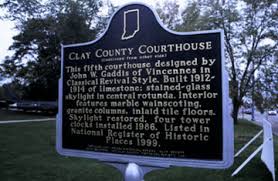
A Clay Circuit Court judge has sent a closely watched Republican primary ballot challenge back to the Indiana Election Commission, ruling that the agency must reconsider whether state Senate candidate Alexandra Wilson is disqualified from office in light of newly presented evidence that her prior felony conviction was expunged.
In a four-page order signed April 2, Special Judge Charles D. Bridges remanded the matter to the Indiana Election Commission for further review rather than issuing a final ruling on Wilson’s eligibility.
The case arose after Jeffrey Gallant, a Vigo County voter, challenged Wilson’s certification as a candidate for Indiana Senate District 38. The Commission held a hearing on Feb. 25, but the vote on disqualification deadlocked 2-2, resulting in no final agency action beyond leaving Wilson on the ballot. Gallant then sought judicial review in Clay Circuit Court under Indiana’s Administrative Orders and Procedures Act.
In his findings, Bridges noted that Wilson presented evidence during the court proceedings showing that her conviction had been expunged by the Vermillion County Circuit Court. However, the judge emphasized that the Election Commission had not been given an opportunity to consider that evidence during its original hearing.
“The Indiana Election Commission has not had an opportunity to consider Wilson’s notice of expungement and whether her candidacy is disqualified in light thereof,” the court wrote.
The order states that under Indiana law, a candidate is not disqualified from running for office if a felony conviction has been expunged. The court specifically cited Indiana Code 3-8-1-5(c)(2)(E), which governs candidate eligibility.
Because judicial review of disputed factual issues is generally limited to the agency record, the court concluded that the appropriate remedy was to remand the matter back to the Election Commission for further consideration rather than decide the issue itself.
The ruling follows a fast-moving procedural history that included an earlier temporary stay halting the mailing of absentee ballots in portions of the district. That stay was later vacated amid concerns about interfering with ballot deadlines and federal absentee voting requirements.
The decision leaves Wilson’s candidacy in place for now while the Election Commission takes up the matter again.
The case has drawn significant attention because it comes in the middle of the 2026 primary election cycle and raises broader questions about how expunged convictions affect ballot eligibility under Indiana law.
For now, the legal question is no longer before the court but returns to the state agency charged with administering Indiana election law.
The Election Commission is expected to consider whether Wilson’s expungement resolves the eligibility challenge and whether any further action is warranted before the May primary.