











by Abdul-Hakim Shabazz, Esq.
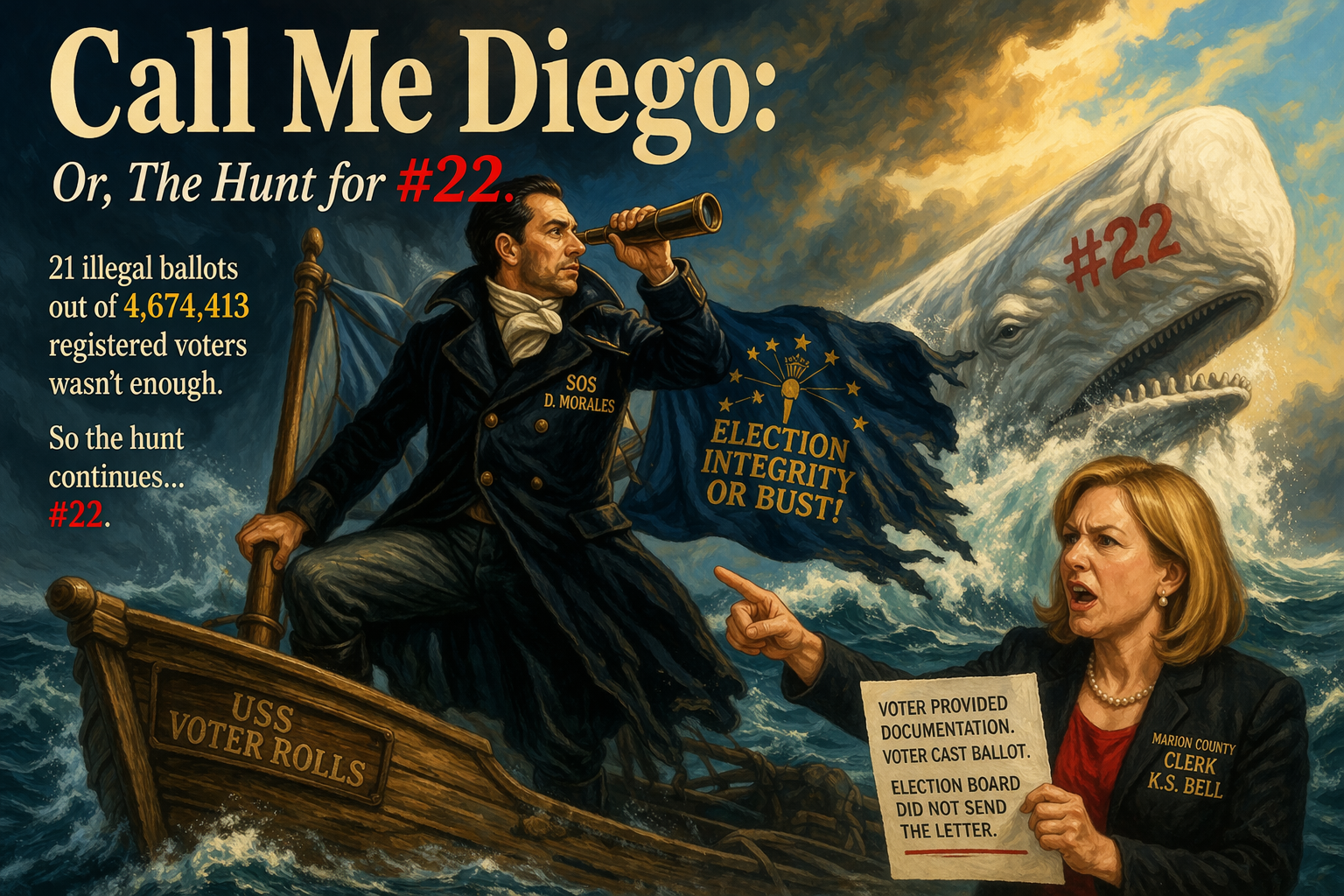
Call me Diego.
Some years ago — never mind how many election cycles precisely, nor how many sternly worded press releases and triumphant declarations of civic salvation have since been loosed upon the waters — there set forth from the port of Indianapolis a most singular mariner, one Diego Morales, bent upon a quest as noble in its self-conception as it was diminutive in its arithmetic.
For upon the vast and teeming sea of 4,674,413 registered Hoosier voters, he had spied, or believed he had spied, twenty-one shadows beneath the waves.
Twenty-one.
Twenty-one ballots, cast unlawfully, so the state now proclaims, from among the millions who crowd the rolls of Indiana. And lo, the captain stood upon the quarterdeck beside his faithful first mate, Todd Rokita, and cried out that the beast had been sighted, that the integrity of the republic had been preserved, that order had once again been restored to the troubled deep.
But ah — what is twenty-one to a man who longs for legend?
What is twenty-one to a captain who hears in every ripple the promise of one more?
Thus begins the hunt for No. 22.
For no sooner had the ink dried upon the proclamation of the twenty-one than the good captain trained his glass eastward, toward Marion County, where a solitary voter had been told he must furnish proof of citizenship ere he might cast his lot in the affairs of the commonwealth.
At once the harpoon was raised.
At once the cry went out that someone had dropped the ball.
At once the great white whale was imagined.
Yet from the shore there answered another voice, that of Clerk Kate Sweeney Bell, who, standing as it were upon the rocky promontory of local administration, did shout back across the surf that the Secretary’s spear had been cast into the wrong sea.
For, as her office most pointedly observed, the Marion County Election Board and the Board of Voter Registration are not one and the same creature, but separate leviathans of bureaucracy, distinct in their duties and jurisdictions.
And then — as so often happens in these great hunts — the whale was found to be rather smaller than first reported.
For the voter, having supplied the requested papers, was in fact permitted to cast his ballot.
He voted.
The ship did not sink.
The republic did not fall.
The stars did not tumble from their courses.
And yet the hunt continues.
For such is the nature of these voyages in an election year: not always to catch the whale, but to be seen forever in pursuit of it.
One suspects that what is sought here is not merely the elusive No. 22, but the spectacle of pursuit itself — the image of the captain, resolute and unblinking, scanning the horizon for the next breach, the next plume, the next morsel of evidence that may be hoisted aloft as proof that he alone keeps watch over the deep.
Call him Diego.
And still he sails.
Editor’s Note / Disclosure:
Abdul-Hakim Shabazz is an attorney licensed in Indiana and Illinois and the editor and publisher of Indy Politics.
And yes, before anyone asks: AI was used in the drafting of this column. Duh. We’ve been clear about this and maintain an AI use and data policy because transparency matters. Here’s the simple way to think about it: AI is a tool. We are still the ones doing the reporting, checking the facts, shaping the argument, and making the editorial decisions and having all the fun. As we like to say: we are the architect; AI is the builder. The vision, design, judgment, and responsibility remain ours.