









by Abdul-Hakim Shabazz, Esq.
I found out Lindsey Graham was gone the way most of us did Saturday night — a push alert, then another, then every wire saying the same thing. Seventy-one years old, taken by a brief and sudden illness at his home on Capitol Hill. For a man who gave 23 years to the Senate and more than three decades to public life, the end came fast, with almost no warning.
I didn’t know Graham well. But I interviewed him once, and it has stuck with me for seventeen years.
It was the fall of 2008. I was at WXNT then, and my friend Mike Biberstine — a good attorney and a better fixer than he’d ever cop to — helped set the whole thing up. We sat down with him at the Indiana GOP headquarters, back when the party was housed in the old opera house on Meridian Street. Graham was in town stumping for John McCain, doing the wingman work he did better than anyone alive. The economy was on fire in the worst possible way. Lehman had gone down, Washington was writing checks with a frightening number of zeros on them, and TARP was the word on every talk-radio caller’s lips.
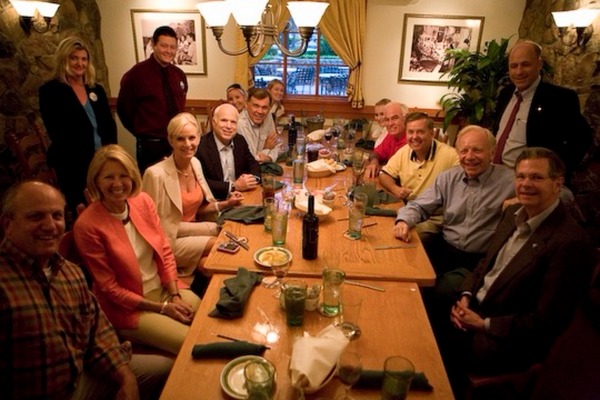
He wasn’t all business, even so. He talked about McCain like a genuine friend — the two of them were close — and laughed about how much they both loved Olive Garden, of all places. Two United States senators bonding over unlimited breadsticks. He was close with Lou Holtz, too, and caught up with the old coach somewhere in that long run around town.
So I asked him about the bailouts — about a Republican administration propping up banks and automakers while the base back home was ready to riot. He didn’t dodge. He leaned in and said, “Abdul, we came into office as social conservatives, but instead governed as conservative socialists.”
It was funny — Graham always had a comic’s timing — but it was more honest than politicians usually let themselves be with a recorder running. He was handing me the quiet part: the party of limited government, when the house was ablaze, had grabbed the same fire hose as everyone else.
Here’s what I can’t stop thinking about this week. In 2008, the thing he was needling was emergency triage — a one-time rescue to keep the whole system from going over the cliff. Even the people who hated TARP understood it as a fire, not a floor plan.
Now look at where his party sits. The federal government — under a Republican president, with a Republican Senate — isn’t lending to companies in a crisis anymore. It’s buying them. Washington holds a stake of nearly 10 percent in Intel, a “golden share” in U.S. Steel, and pieces of more than a dozen other firms across chips, steel, rare earths, and nuclear power. And here’s the part that would have made 2008 Graham grin: nobody calls it a bailout. The administration calls it strategy. National security. A smart investment for the taxpayer.
Which is a fancier way of saying what Graham told me in that old opera house seventeen years ago. We came in as social conservatives and governed as conservative socialists — except now it isn’t a panic, and it isn’t temporary. It’s the plan. The party that spent my entire career warning about government picking winners and losers has decided it would rather own the winners outright.
I don’t know what Graham would say about all of it today. He changed over the years; so did the ground beneath him. This was a man who helped prosecute Bill Clinton as a House impeachment manager in 1999, insisting it was about protecting the office and not punishing the man — and who, two decades later, became one of the fiercest defenders of a president facing the same process. Same institution, opposite chair. But the man I interviewed in 2008 had a gift for naming the thing everyone else was too disciplined to say out loud. If he were still doing radio hits, I suspect he’d look at his own side’s balance sheet, flash that grin, and tell some reporter the punchline had finally become the policy.
Mike Biberstine, the friend who set the whole thing up, remembers that day better than I do in one respect. Back then he was in the Office of Corporation Counsel under Mayor Greg Ballard, and he took the day off to play driver, ferrying Graham from stop to stop. The politics aren’t what stuck with him. “The biggest thing I remember,” he told me this week, “is that he was very polite and genuinely nice to everyone we met with over that long day.”
That’s the part that never makes the wire copy, and maybe the part worth keeping. Not the balance sheet, not the arc — just a man who was decent to the room on a long day when nobody was keeping score.
Rest easy, Senator. You always did know how to land a line.
Abdul-Hakim Shabazz is a licensed attorney (Indiana and Illinois) and the editor and publisher of Indy Politics.
Photo Courtesy Mike Biberstine.