


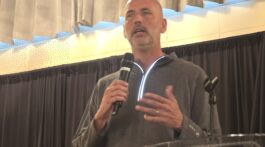



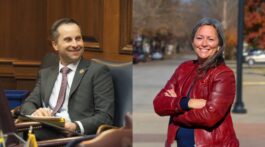




Marion County Prosecutor Ryan Mears defended his record on crime, clarified his office’s role in immigration enforcement, and outlined his priorities heading into November during a brief conversation at a westside candidate forum.
Speaking at a community event near his alma mater, Cardinal Ritter High School, Mears said his office’s central mission is to protect victims and maintain trust with the community, not to participate in federal immigration crackdowns.
Mears addressed concerns about recent immigration enforcement actions involving masked agents detaining individuals, saying such tactics can create fear and undermine confidence in government.
He stressed that a person’s immigration status “is not our concern,” and that his office is focused on ensuring victims and witnesses are treated “with dignity and respect” so they feel safe coming forward with information needed to prosecute crimes.
Mears rejected the notion that he is defying federal law, arguing instead that his office simply lacks jurisdiction over immigration matters. He compared it to being asked to enforce the Clean Air Act, saying county prosecutors do not have authority over federal regulatory schemes.
On his record, Mears pushed back against critics — including some within law enforcement — who claim he is soft on crime or too lenient in plea agreements. He pointed to what he described as a 90 percent conviction rate on homicide cases over the past three years, including a recent case in which a woman was sentenced to life without parole after a jury found aggravating circumstances.
Mears acknowledged his controversial decision not to prosecute simple possession of marijuana but maintained that overall results show his approach is working. He cited homicide numbers that he said have fallen to levels not seen since 2004–2005, and noted that even the local police department has reported historically low violent crime in some categories.
Mears also addressed a legal controversy stemming from Broad Ripple, where two judges reached opposite conclusions on what he described as essentially identical tax-related cases developed in partnership with the state Department of Revenue. One judge upheld the case; another did not. Mears said that kind of split is precisely why the Indiana Court of Appeals exists — to act as a tiebreaker when trial courts disagree.
Looking ahead, Mears brushed off speculation that he might use the prosecutor’s office as a stepping stone to a mayoral run. He emphasized that he has spent 20 years in the Marion County Prosecutor’s Office and that it is the only office he has ever sought.
He did, however, note his frustration that many of the issues feeding into crime — such as housing, mental health, addiction, and school performance — lie outside the formal powers of his office, even though prosecutors see the consequences every day.
As the election approaches, Mears said his message to voters will center on continued engagement with the community, maintaining strong results in serious felony prosecutions, and focusing on problem-solving for low-level offenses. For those cases, he said, the goal is less about punishment and more about changing behavior when resources for treatment and support are available.