





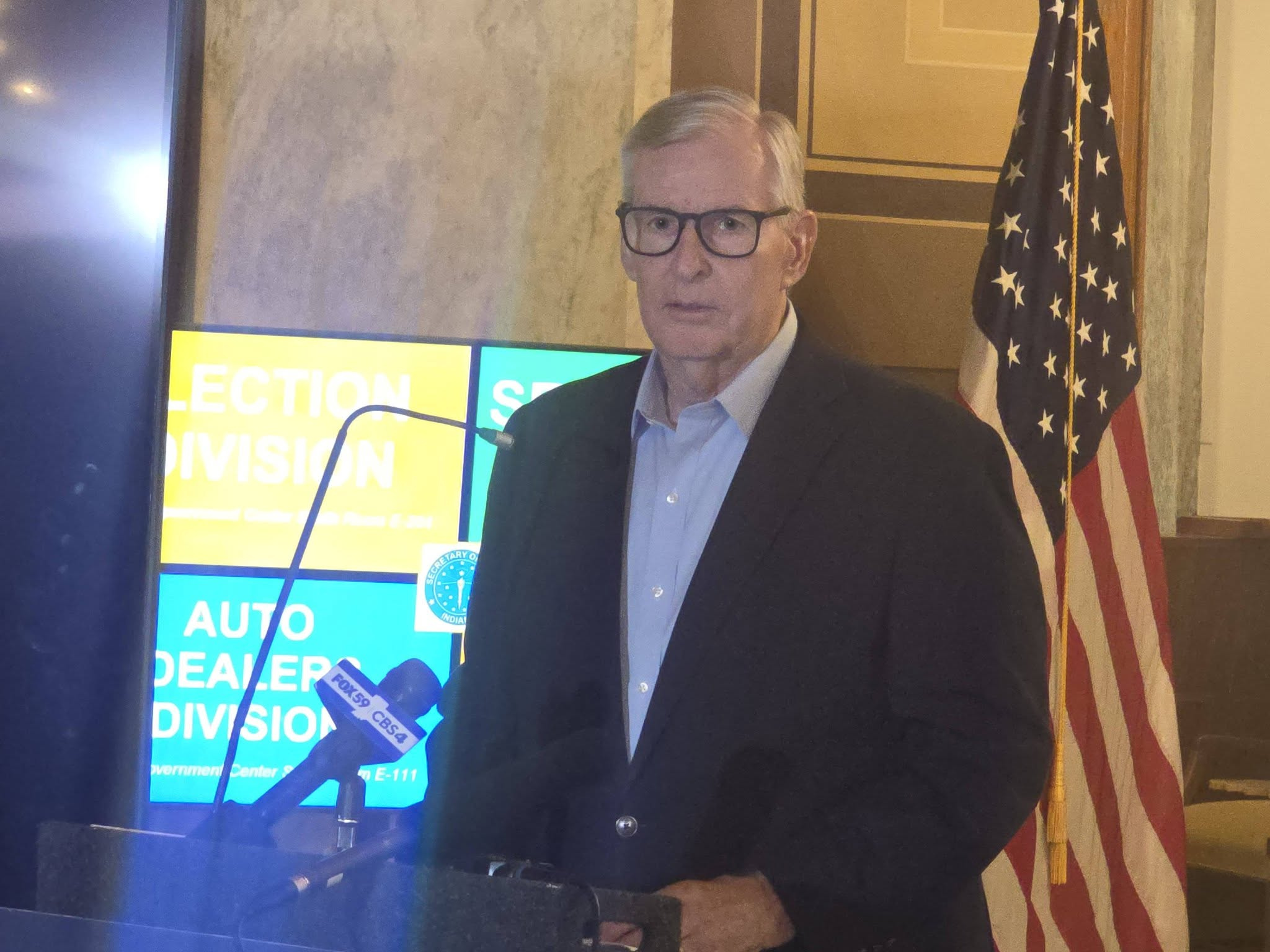
Secretary of State candidate Greg Ballard filed suit Thursday in Marion Superior Court asking a judge to order the Indiana Election Commission to meet before the Nov. 3 election and act on four campaign finance complaints pending against his two major-party opponents.
Ballard, the former two-term Indianapolis mayor running as the Lincoln Party candidate, filed the verified complaint pro se against the commission, Chair Beth Boyce, and members Suzannah Wilson Overholt, Karen Celestino-Horseman and John Westercamp, all in their official capacities. He delivered notice of the suit to the commission through the Indiana Election Division Thursday morning.
Two of the complaints target Republican Max Engling’s campaign. Two target Democrat Beau Bayh’s.
The first, filed July 24 by David Shelton of Knox County, alleges the Engling campaign accepted a $60,000 contribution from Hoosier Leadership for America, Inc. on or about June 30, exceeding the $5,000 annual limit on corporate contributions to state candidates, and reported it as coming from a non-corporate source. According to the lawsuit, the Engling campaign has told the press it refunded the money around July 14, but no evidence of the refund has been filed with the commission.
A Sept. 15 complaint by Chris Douglas of Marion County alleges a Hoosier Leadership for America event the night before the Republican state convention, at which Engling was listed as a special guest, was an in-kind contribution the campaign failed to report.
The Bayh complaints were filed in September. Danny K. Shields of Monroe County alleges fundraisers, receptions and other events Bayh has attended as a candidate were unreported in-kind contributions. Michael Neal of Hamilton County alleges unreported in-kind contributions tied to Democratic Party events and printed materials that lacked required disclaimers.
The commission last met July 24, the day the Shelton complaint was filed. As of Oct. 10, its website said no meetings were scheduled, according to the suit. The filing notes the commission met before the general election in both 2022 and 2024, on Sept. 9 and Sept. 30, respectively, to take up campaign finance matters.
Under state law, the chair calls commission meetings. The vice chair may call one with the written approval of the other two members. The suit, citing an Indianapolis Star report, says Overholt and Celestino-Horseman have stated publicly that the commission should hear every complaint filed with it.
The lawsuit seeks a declaratory judgment, an injunction and an order of mandate requiring the commission to hold a public meeting, noticed under the Open Door Law, by Oct. 26 and determine whether there is substantial reason to believe a violation occurred in each case. Ballard does not ask the court to decide the outcome of the complaints.
In a letter to Boyce dated Thursday, Ballard wrote that if the chair calls a properly noticed meeting before Oct. 26, “the court’s involvement becomes unnecessary and I will say so to the court.”
“I am not asking the Commission to rule for or against anyone. I am asking it to meet,” Ballard wrote.
Early voting began Oct. 6. The suit argues a decision made after Election Day would come too late to inform voters.
The filing also states that a public records request was submitted to the Election Division on Ballard’s behalf on Oct. 12 for the complaints and related correspondence, and that no records had been produced as of filing.