









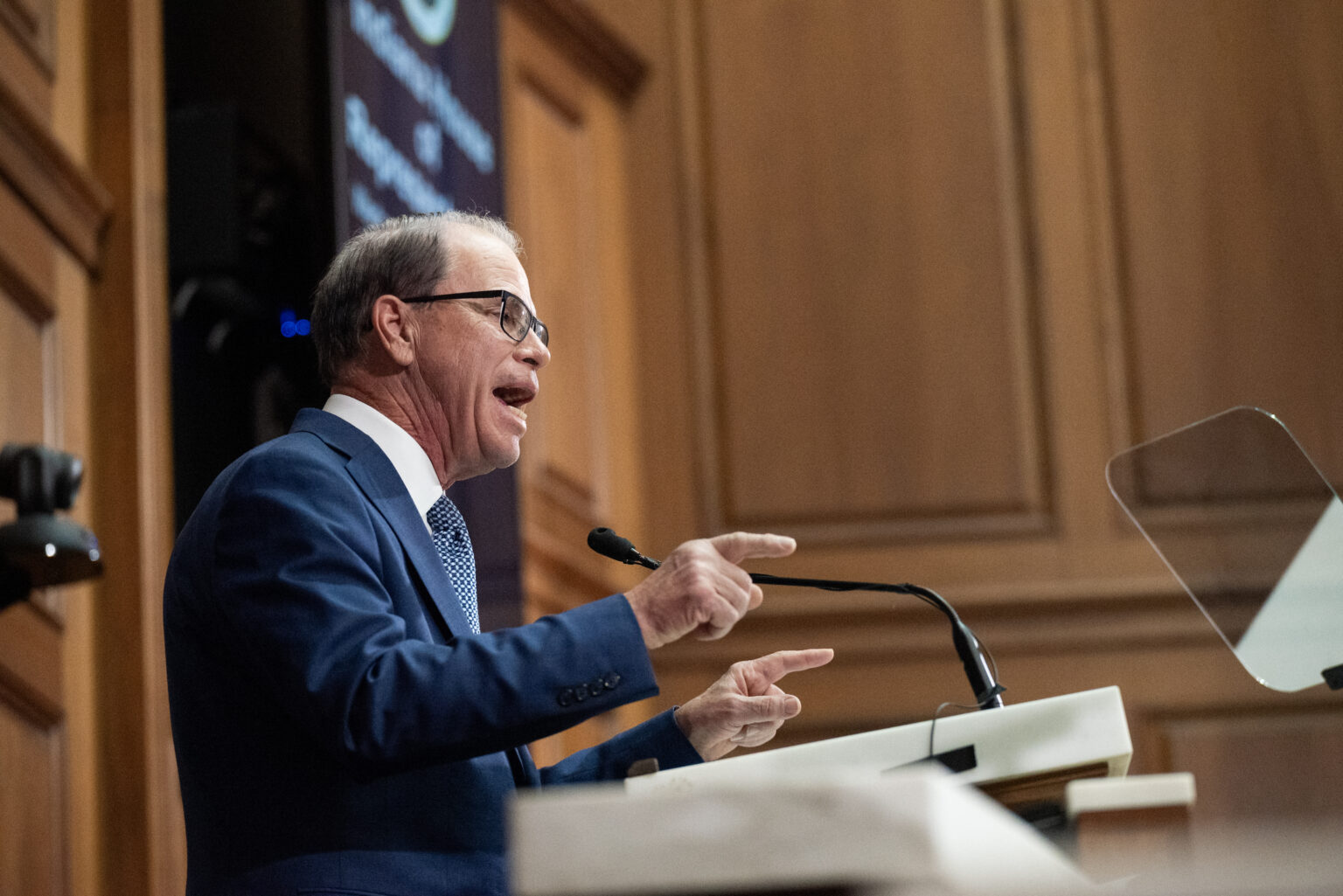
A new statewide survey suggests Governor Mike Braun may be facing more than routine governing turbulence.
The February 20–21 Public Policy Polling survey of 554 Indiana voters places Braun at 25% approval, 53% disapproval, and 22% unsure.
In a state that voted 56% for Donald Trump in 2024, that number is not simply soft. It is structurally weak.
Approval below 30% is difficult terrain for any incumbent executive. But the greater concern for Braun is not just the topline — it is the breadth of dissatisfaction.
Among Republicans, only 43% approve of his performance, while 27% disapprove and 30% remain unsure. That level of ambivalence within one’s own party suggests incomplete consolidation. Independents disapprove at 60%. Democrats at 88%. Women disapprove at 62%. Voters aged 46–65 — a reliable turnout cohort — register 55% disapproval. In the Indianapolis media market, disapproval significantly outpaces approval.
This is not a regional pocket of discontent. It is statewide.
Enter the Mid-States Corridor.
The proposed $1.1 billion, 23-mile highway through Dubois County has become the most visible policy flashpoint. Statewide, 65% oppose the project, including 41% who strongly oppose it. Seventy-four percent say it should be canceled outright.
Eighty-eight percent would prefer redirecting funds to local road and bridge projects across Indiana. Eighty-five percent say that if local residents oppose a highway project, the state should respect that opposition. Seventy-four percent say that if the Legislature cancels the project and Braun vetoes it, lawmakers should override that veto.
These are not marginal numbers. They are durable, cross-partisan majorities.
Even among Republicans, 65% favor canceling the Corridor. Sixty-four percent of Republican voters support overriding a veto. Independents are even more decisive. The issue does not divide neatly along ideological lines; it unites voters around fiscal prioritization and local control.
For many voters outside southern Indiana, the Corridor may not be personally relevant. But that may not matter. Once a $1.1 billion project becomes closely associated with the Governor — particularly amid broader dissatisfaction — it functions less as a regional infrastructure proposal and more as shorthand for executive priorities. In statewide politics, association travels faster than pavement.
The implications extend beyond one highway.
Seventy-six percent of voters say that when a governor pushes policies most voters oppose, the Legislature should act as a check rather than defer. That sentiment cuts across party identification and geography. In a state with a Republican supermajority, such numbers create quiet but consequential incentives.
If a state legislator votes to cancel the Corridor and redirect funding locally, 56% of voters say they would be more likely to support that legislator, compared to just 6% who would be less likely. That is a substantial net political benefit.
In other words, distance from the Governor on this issue is not merely defensible. It is potentially advantageous.
Reelection campaigns are built on coalition stability: a consolidated base, persuadable independents, and institutional alignment. At present, the polling suggests friction in all three areas. Republicans are not uniformly enthusiastic. Independents are decisively negative. And voters broadly prefer a Legislature willing to check executive authority.
It is far too early to write any political epitaph. Governors can recover. Economies shift. Narratives change.
But incumbents rarely rebound from sub-30% approval without a stabilizing achievement or recalibration.
Instead, Braun currently faces a defining policy fight where the numbers break overwhelmingly against him — and where the broader electorate appears more inclined toward legislative independence than executive assertiveness.
The road to reelection is never linear.
At the moment, however, the data suggest that unless the trajectory changes, the Governor may be traveling a far narrower path than anticipated.
And in Indiana politics, narrow paths do not always lead to second terms.