

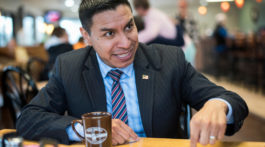






Indiana’s chief election officer is now the subject of a formal ethics complaint after the Marion County Election Board voted to refer Secretary of State Diego Morales to state watchdog agencies over what local officials say was an improper use of government resources for campaign purposes.
At the center of the dispute is a visit Morales made to the Marion County Election Service Center, where his official staff recorded video of him greeting election workers and bipartisan ballot-processing teams inside the county’s central count facility.
According to Marion County Clerk Kate Sweeney Bell, the issue arose when that footage — recorded by state employees during an official visit — later appeared in a political campaign advertisement.
Bell said using video produced by state staff during an official visit in campaign materials could violate Indiana’s ethics laws governing the use of taxpayer-funded personnel and resources. “That crosses a bright line,” Bell said after the board meeting. “Government resources cannot be used for political purposes.”
Bell said county officials repeatedly asked the Secretary of State’s office to remove the footage from the campaign advertisement. Those requests, she said, were either ignored or rejected. “The response we received was essentially that they did not believe they had to take it down,” Bell said.
With no resolution, the Marion County Election Board voted to refer the matter to both the Indiana Inspector General and the State Ethics Commission for investigation. Board attorneys advised members that the issue likely falls under Title 4 of Indiana law, which governs the conduct of state officials and the use of state resources, rather than Title 3, which primarily governs election administration.
Bell did not downplay the seriousness of the allegations. While the board itself cannot impose penalties, the Inspector General and Ethics Commission have the authority to investigate ethics violations and impose civil sanctions if wrongdoing is found.
“A censure is essentially a slap on the wrist,” Bell said. “The Inspector General and Ethics Commission have tools that can impose real consequences.”
As a result of the dispute, Bell said the Secretary of State is now barred from entering non-public areas of the Election Service Center.
She described the move as a necessary step to protect election workers and ballot processing operations from becoming part of a political controversy.
“These workers didn’t ask to be part of this,” she said.
Bell also addressed questions about whether the case would be referred to the Marion County Prosecutor’s Office. According to the board’s legal counsel, she said, referral to the Inspector General and Ethics Commission was the more appropriate course.
The clerk said she has greater confidence in the Inspector General’s ability to review the complaint independently.
Bell also noted that Morales and Indiana Attorney General Todd Rokita have worked closely together politically, adding that the Inspector General’s office provides a more independent review process. “We believe the Inspector General has the independence to look at this and take appropriate action,” she said.
Bell framed the dispute as a broader issue of accountability in election administration. “There is one set of rules for everyone,” she said. “Whether you’re the Secretary of State or the smallest county officeholder in Indiana.” And if those rules are broken, she said, election officials have a responsibility to act. Across Indiana’s 92 counties,” Bell said, “I don’t think any clerk would say this behavior is acceptable.”