










By Abdul-Hakim Shabazz, Esq.
Every now and then, the early voting numbers tell you something before anyone in politics is willing to say it out loud. This is one of those times.
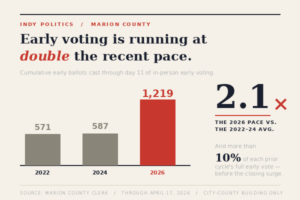
Through the first eleven days of in-person early voting in Marion County, 1,219 ballots have been cast. At the same point in 2022, the running total was 571. In 2024, it was 587.
Do the math. That’s roughly 2.1 times the pace of the two most recent primaries. It’s also more than 10 percent of the total early vote from either of those cycles — and we’re not even to the final stretch yet. The weekend before Election Day hasn’t happened. The final Monday hasn’t happened. What’s happened is eleven days of regular weekday voting, and Marion County is already running laps around its own recent history.
Early voting through day 11 has already surpassed 2022 and 2024 combined.
The daily numbers say the same thing. Opening day this year: 180 ballots. Opening day 2024: 98. Opening day 2022: 82. Every weekday since has outrun its counterpart in both prior cycles, most by 60 to 90 ballots. Friday, April 17 came in at 155 — the strongest day of the cycle so far. Whatever’s happening, it’s not cooling off. It’s heating up.
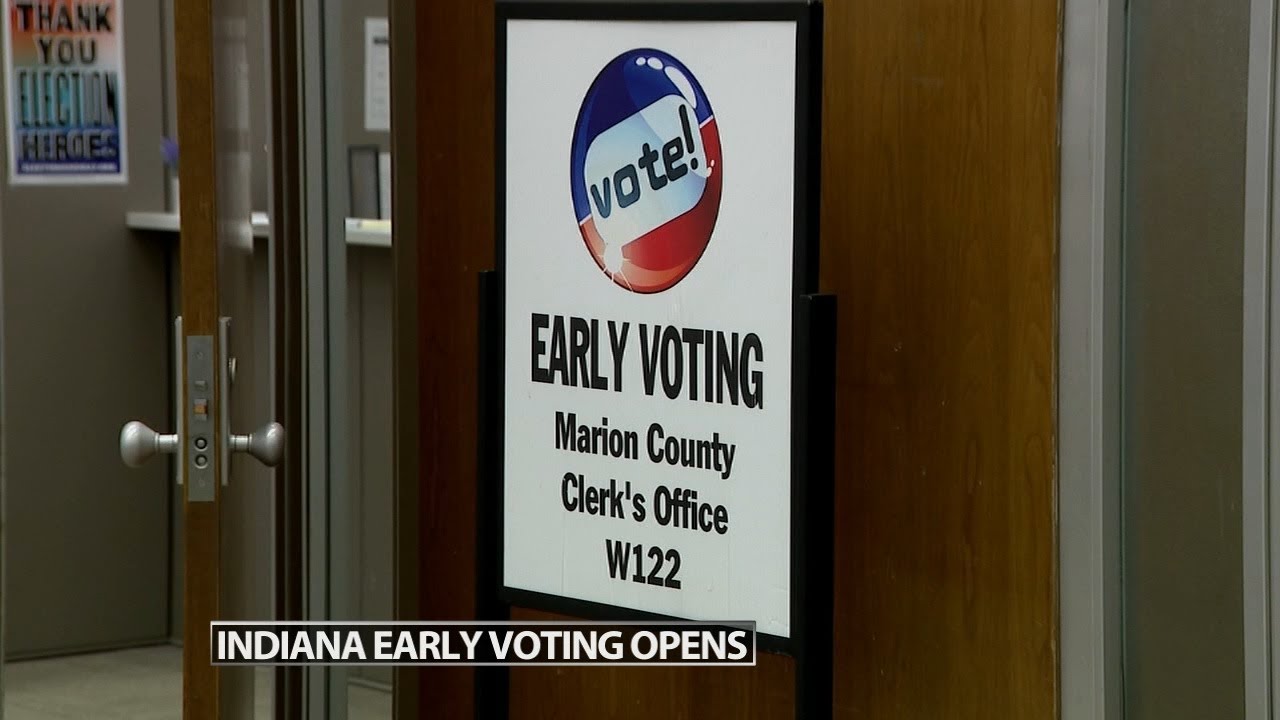
And here’s the part that really ought to make people sit up. All of this — every one of those 1,219 ballots — has been cast at a single location. The City-County Building downtown. That’s it. The satellite vote centers don’t open until this weekend. In other words, Marion County is doubling the pace of recent primaries with one early voting site operating. When the vote centers come online, the ceiling goes up.
A quick note on why 2020 isn’t in this comparison. 2020 was the COVID cycle. The primary got pushed from May to June. No-excuse absentee voting was temporarily wide open. Turnout patterns across early, absentee, and Election Day looked nothing like a normal year. Tossing 2020 into this comparison would muddy the water, not clarify it. 2022 and 2024 are the cleaner read.
So what’s driving it? Look at the ballot.
Start at the top. The Democratic primary in the 7th Congressional District is actually a race this year. Andre Carson, who in recent cycles has cruised through his primaries without much organized opposition, is facing three challengers. There’s money. There’s mail. There’s paid media. There are voter-contact operations that didn’t exist last cycle. Because CD 7 covers most of Marion County, a contested primary at the top of the ticket pulls turnout from every corner of the county. That alone moves the numbers.
Now add the two open State Senate seats.
Senate District 29 is open because J.D. Ford is running for Congress. Seven candidates across the two primaries — four Democrats and three Republicans, including two former state senators on the GOP side — are in the mix. Senate District 31 is open because Kyle Walker decided not to run again after opposing the Trump-backed redistricting push. Walker won SD 31 in 2022 with 55 percent of the vote, which in Indiana Senate terms makes it a genuinely competitive seat. Eight candidates are running, including Marion County Sheriff Kerry Forestal on the Democratic side. In a swing district, the primary isn’t a formality — it effectively picks the next senator.
And that’s before you get to the broader Marion County Democratic ballot — contested legislative primaries, delegate races, seats that in 2022 or 2024 would have been afterthoughts. For a meaningful chunk of Marion County voters, this year’s ballot actually asks them to make real decisions. Multiple ones.
Here’s the thing about contested races. They build the turnout machinery that early voting runs on. Mail pieces. Doors. Texts. Volunteers. Peer-to-peer outreach from people who believe their vote matters because — in a competitive primary — it actually does. That machinery isn’t constant from cycle to cycle. It scales with the ballot. And the 2026 ballot has a lot more of it than the last two primaries did.
Two caveats worth keeping in mind.
First, day 11 has historically accounted for about 5 percent of the total early vote. The bulk shows up in the final weekend and the Monday before Election Day. That means small numbers now can translate into big projected numbers later — and projections aren’t reality. If 2026 tracks the late-cycle ramp of 2022 and 2024, the final early vote lands somewhere around 24,000 ballots, roughly double the recent baseline. Big if.
Second, heavy early voting doesn’t automatically mean a bigger electorate. It could just mean voters who would have shown up on May 5 are showing up in April instead. We won’t know which until the final week and Election Day itself produce their own numbers.
But here’s what we can say. The 2026 pace isn’t noise. It isn’t a one-day blip. It’s a sustained, daily departure from both 2022 and 2024, and it lines up with a ballot that looks materially different from either of those years. Not different rules. Not a different calendar. A different ballot.
Voters respond to what’s in front of them. Right now, what’s in front of them is a primary with actual stakes.
The next two weeks will tell us whether this pace holds, and whether it translates into bigger turnout or just earlier turnout. Either way, the Clerk’s office is publishing numbers that deserve more attention than they’ve been getting.
Abdul-Hakim Shabazz is the editor and publisher of Indy Politics. He is also an attorney licensed in Indiana and Illinois.