





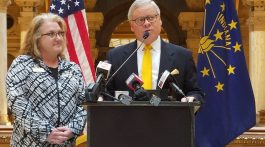





Democratic congressional candidate George Hornedo is making his case for new leadership in Indiana’s 7th District, arguing that a combination of accountability, effectiveness, and voter engagement has been missing under longtime incumbent Andre Carson.
In a recent conversation with Indy Politics, Hornedo acknowledged the uphill nature of challenging an 18-year incumbent, describing the decision to run as one that might seem “crazy” at first glance. But he said his campaign has been fueled by a contrast he sees between the often negative tone of political discourse online and what he describes as a more hopeful and resilient electorate encountered through direct voter contact.
“For me, it came down to a choice between stepping away and stepping up,” Hornedo said. “I chose to step up.”
Hornedo has centered his campaign on three main themes: accountability, effectiveness, and what he characterizes as the risks of one-party complacency.
On fundraising and accountability, Hornedo drew a sharp distinction between his campaign and Carson’s. He said his campaign is funded entirely by individual donors, with roughly 80% coming from small-dollar contributions, and emphasized that he has not accepted corporate PAC money. By contrast, Hornedo pointed to campaign finance data showing that a significant portion of Carson’s funding comes from political action committees, including corporate and defense-related PACs, while a smaller share comes from grassroots donors. Hornedo argued that such funding patterns raise questions for voters about representation and influence in Washington.
Hornedo also challenged Carson’s legislative record, citing rankings from the Center for Effective Lawmaking that place Carson in the lower tier of House members in terms of legislative effectiveness. While Carson has highlighted the passage of 22 bills during his tenure, Hornedo noted that only two were standalone measures he led, both of which were ceremonial in nature. Hornedo contrasted that record with his own work as an attorney and advocate, saying he helped secure nearly $800 million in funding for communities across the country over a three-year period.
Another key element of Hornedo’s campaign is his focus on voter engagement and turnout. He argued that decades of Democratic control in the district have contributed to declining participation, with the 7th District moving from historically strong turnout levels during the tenure of Julia Carson to lower levels in recent years. According to Hornedo, a lack of competitive primaries has reduced incentives for sustained voter outreach.
Hornedo pointed to his campaign’s field efforts as evidence of a different approach, citing more than 40,000 doors knocked, over 1.5 million voter contact attempts, and more than 16,000 one-on-one conversations with constituents.
Infrastructure, particularly road funding, has emerged as a central policy issue in the campaign. Hornedo said it is the most frequently raised concern among voters and proposed pursuing changes to federal transportation funding formulas during the next Surface Transportation Reauthorization process. He argued that Indianapolis and similar cities are not receiving an equitable share of funding and said a coalition-based approach in Congress could help address the imbalance.
Hornedo also criticized Carson’s visibility in the district, including his handling of local issues such as a controversial data center project, and positioned himself as a more accessible and community-focused alternative.