


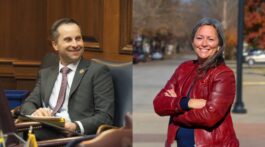





One served a Republican president. The other served a Democrat. Both came to Gainbridge Fieldhouse Wednesday morning with the same warning: the bipartisan rush to redraw congressional maps between censuses is corrosive to American democracy, and someone needs to break the fever.
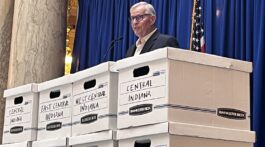
Ari Fleischer, who served as White House Press Secretary under President George W. Bush, and Jeff Eller, a former Deputy Assistant to President Bill Clinton and Director of Media Affairs, headlined the Benjamin Harrison Presidential Site’s annual “Off the Record” panel the morning after Indiana’s primary delivered decisive wins for candidates backed by President Donald Trump — many of whom campaigned on redrawing Indiana’s congressional districts ahead of November.
Neither man was buying.
“I bemoan this entire redistricting,” Fleischer said. “Redistricting should be once every 10 years after the census. There are so few things that seem to hold Americans together anymore, and we cannot turn to every two years, both parties just trying to grab power.”
Fleischer compared the practice to an illness both parties have caught, tracing the current cycle back to New York and North Carolina before it spread to Texas and beyond. He drew a sharp line, however, between mid-cycle gerrymandering and the recent Supreme Court decision limiting race-based districting, saying he supports the latter while opposing the former.
Eller, who built the Clinton White House’s local-media strategy in the early 1990s, called mid-decade redistricting a genie that will be hard to put back in the bottle.
“The 10-year cycle was predictable based on good data,” Eller said. “This mid-cycle redistricting, I think, is overall counterproductive to longer-term efforts on both keeping people engaged and furthering democracy.”
Asked about Tuesday’s results in Indiana — where Trump’s involvement in Statehouse primaries was unusually visible — Eller noted that every White House tracks local races through its political affairs office. The difference now, he said, is exposure.
“Presidential interest and involvement in local politics has always been there,” Eller said. “I think the difference today is it’s a lot more visible.”
The conversation also turned to the press itself. Fleischer, predictably the more pointed of the two on media criticism, argued that journalism’s coverage of Trump — beginning before his first election — has fueled the country’s polarization. He urged a return to neutral, fact-driven reporting while acknowledging that openly partisan outlets are proliferating.
“You have to rely on the desire of the American people to simply be told the truth, not to be told opinions,” Fleischer said. “There’s always going to be opinion journalism, and it’s valuable, but that can’t be America’s only journalism.”
Both men said artificial intelligence is reshaping how campaigns and newsrooms operate, but neither viewed it as a replacement for human judgment. Eller, who described himself as an AI advocate, said the technology shortens an already compressed news cycle but cannot substitute for experience or editorial scrutiny.
Asked what advice he had for Indiana Republicans and Democrats heading into November, Fleischer demurred on offering specifics but praised the state’s earlier resistance to redistricting alongside Maryland — a stand that, he noted, may not survive the current political moment.
“In defeat, there is the solace that you stood on principle,” he said.
The panel was moderated by Visit Indy’s Morgan Snyder and hosted by the Benjamin Harrison Presidential Site as part of its ongoing public affairs programming.
Audio from Ari Fleischer, Jeff Eller, and USA Today’s Maureen Groppe is available above.