











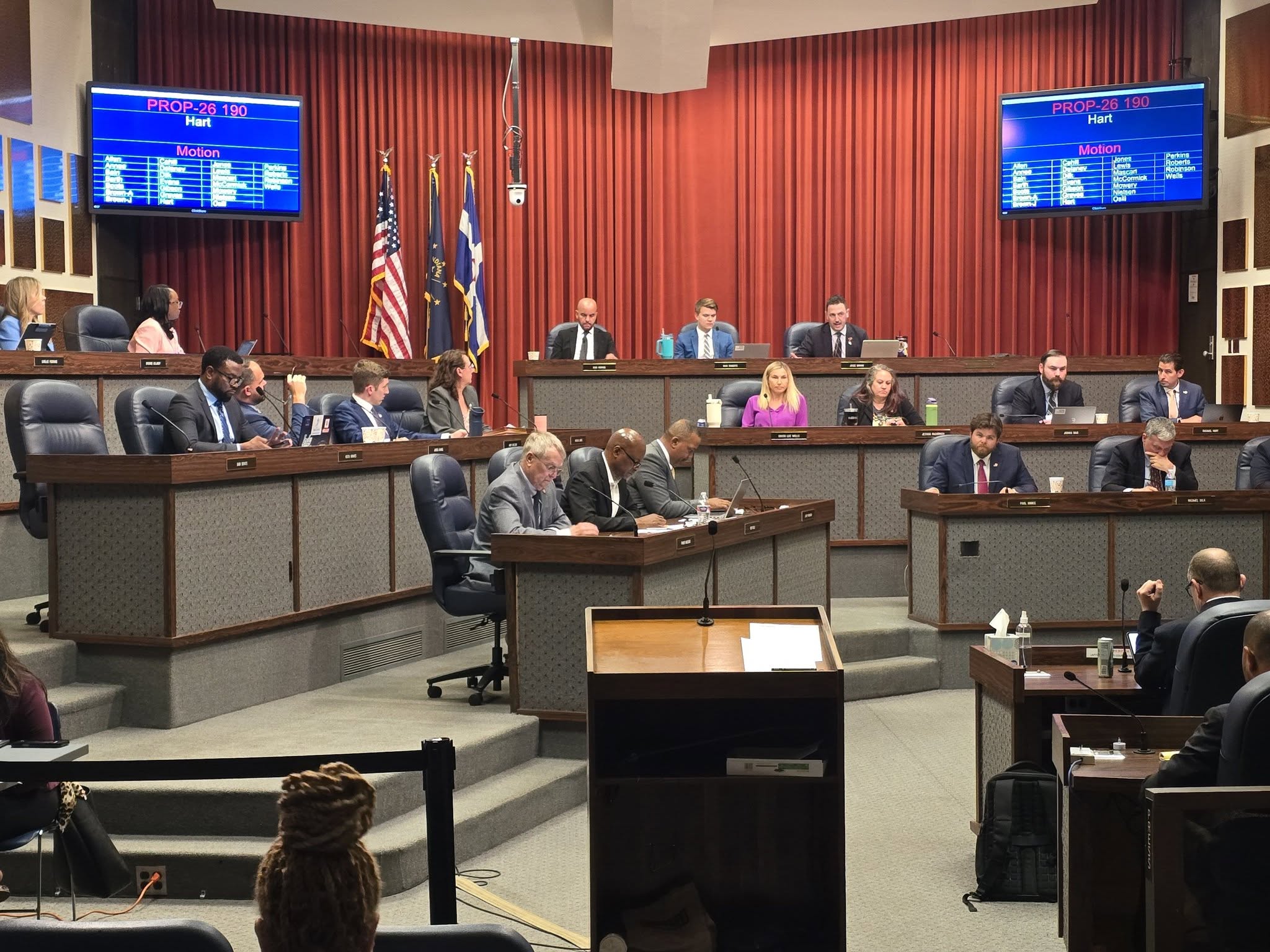
Indianapolis City-County Council Democrats say they do not have the votes to override Mayor Joe Hogsett’s veto of the wheel tax increase.
Leadership released a statement Wednesday saying an override requires seventeen votes — and as of today, they don’t have them. The council is scheduled to take up the override Monday.
Hogsett vetoed the vehicle excise surtax and wheel tax increase on July sixteenth. In a recorded veto message, the mayor said the increase asks too much of residents at a time when households are already stretched, and that his administration can meet the state’s funding requirements without it. He also said that plan had already been shared with the council.
Democrats disagreed then, and they disagreed again this week. Their statement says the city has not fully identified where the money will come from.
At issue is a fifty-million-dollar local match. Indianapolis has to put up that money to receive fifty million dollars in state road funding next year. Council Democrats warn that finding it inside the twenty-twenty-seven budget means reduced services, fewer resources, and possibly fewer city employees.
The statement also returns to a longer-running complaint — that the city still has no long-term plan for its aging roads and alleys. Leadership says Indianapolis cannot call itself a world-class city and expect residents to accept the current condition of its streets as a strategy.
Here’s what state law actually requires.
The match has to come from new revenue. The statute names two things the city cannot use — other state road distributions, and local income tax dollars set aside for public safety. It does not specify how the revenue has to be raised.
That leaves other options available. Growth in income tax collections outside public safety falls outside the exclusions. So does stormwater revenue. Whether growth in an existing revenue stream counts as new revenue is the core disagreement between the mayor’s office and the council — and the law does not say who decides. The city notifies the state comptroller itself.
The wheel tax was never a condition of the fifty million. That requirement appears in a separate part of the statute, governing a different distribution to local units statewide. Marion County already levies a wheel tax and an excise tax. The proposal would have increased them.
Where the law is strict is the calendar. Indianapolis has to tell the state comptroller by December thirty-first whether it can provide the match. And if the city can’t provide it in any single year, it becomes ineligible for the state money in every year after that.
The match also grows. Seventy million dollars in twenty-twenty-eight. Eighty million in twenty-twenty-nine. Ninety million in twenty-thirty. And a hundred million in twenty-thirty-one and beyond — with part of each increase required to be revenue the city hasn’t already counted.
Council President Maggie Lewis called on the mayor last month to produce his own funding plan.
The statement does not say whether Democrats will still bring the override to a vote, or how many members are expected to break with leadership.
The council meets Monday.