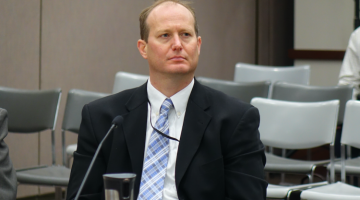











Republican attorney Phil Foust says Indianapolis is being held back by what he calls soft-on-crime policies and a prosecutor’s office that’s lost the trust of police and the public.
Foust is running for Marion County Prosecutor, challenging incumbent Ryan Mears. He tells us he loves Indianapolis, grew up in Pike Township, went to IUPUI, and later Harvard Law School before coming back home to work as a prosecutor.
He interned under former Republican prosecutor Carl Brizzi, then served under Democrat Terry Curry, and briefly under Mears. Foust says Brizzi was tough on crime, while Curry focused on fairness, integrity, and keeping politics out of day‑to‑day decisions. He argues that under Mears, that balance is gone.
One of Foust’s main themes is juvenile crime. He calls it a “five‑alarm fire” and says too many teens have “no respect and no fear” of the juvenile justice system. He criticizes the system as too secretive and too quick to release serious offenders, and says the public would be shocked if they could see a full day in juvenile court. He wants more transparency and tougher, more consistent consequences for repeat juvenile offenders.
Foust also rejects the idea that Marion County is locking up too many people. He says a small group of repeat offenders is responsible for a big share of the crime, and that the county isn’t using all the tools it already has — things like habitual offender, gang, and firearm sentencing enhancements, and tougher enforcement against serious violent felons caught with guns. He promises to review how those tools are used in his first 100 days.
A big part of his pitch is about rebuilding relationships with law enforcement. Foust says the relationship between the prosecutor’s office and IMPD is “at an all‑time low,” and describes it as “absolute antagonism.” He criticizes Mears for pulling prosecutors out of district offices, which he says makes it harder for new detectives to build solid cases. He also notes the prosecutor’s office doesn’t regularly attend a weekly violence prevention task force that brings together local, state, and federal partners — and says in a county the size of Marion, public safety “requires teamwork.”
Foust points to concern from mayors and prosecutors in the surrounding “donut counties,” who say crime in Indianapolis doesn’t stop at the county line. He argues some offenders deliberately choose Marion County because they expect lighter consequences, and says he’d work to repair relationships and improve information‑sharing with neighboring counties and with the Indiana Prosecuting Attorneys Council.
On domestic violence, Foust says those cases can turn deadly quickly and can’t be treated as routine, even when victims later hesitate to cooperate. He also leans into public corruption issues, criticizing how Mears initiated a tax case probe in Broad Ripple but now says his office can’t independently investigate allegations involving the Hogsett administration without a police referral. Foust calls that a double standard and says a special prosecutor should handle both matters to avoid any appearance of political motivation.
Finally, Foust is a Republican running in a strongly Democratic county, but says his message is aimed at moderates, independents, and disillusioned Democrats who are worried about basic public safety. He argues the prosecutor’s office should be focused on enforcing the law, seeking justice for victims, and protecting the public — not, in his words, “ideological pet projects” or positioning for a future run for mayor.