









by Tom Davies, Indiana Capital Chronicle
August 5, 2026
Indiana’s gasoline tax holiday will continue for at least 30 more days.
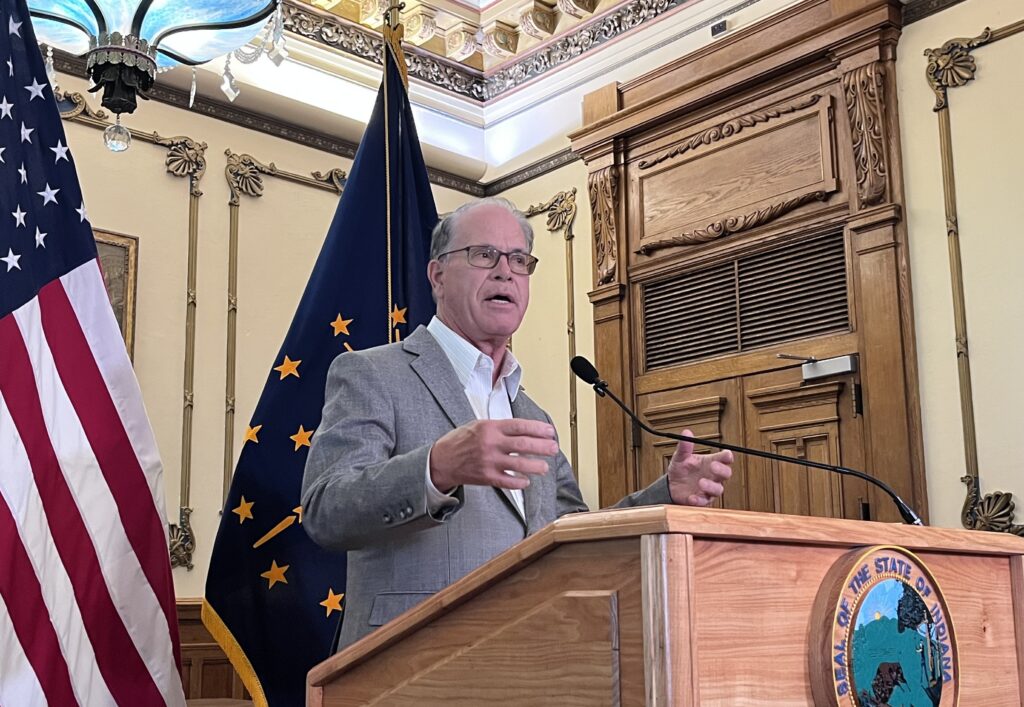
Gov. Mike Braun issued a new executive order Wednesday suspending the state’s gas taxes totalling 58.9 cents a gallon that were set to be reimposed Friday. The new suspension continues through Sept. 5.
The governor said last month he didn’t have the power to continue the tax break without the Legislature coming into special session and authorizing another extension.
But Braun said Wednesday he was declaring a new emergency under the state’s energy emergency law. This time he is citing disruptions to global oil shipping lanes from the four-year-old Russian invasion of Ukraine rather than the U.S. war with Iran. He also pointed to troubles the Canadian wildfires have caused in the Alberta Oil Sands Region.
“These disruptions have created new pressures on fuel prices that are driving the price of gas for Hoosiers to unnatural levels outside the norm of standard economic conditions,” Braun said during a Statehouse news conference. “I will reevaluate in 30 days to determine whether another pause is necessary.”
The governor first partially suspended the gas taxes by executive order on April 8 following the spike in worldwide oil prices after President Donald Trump launched the war with Iran in February.
Braun fully suspended the taxes in May, but the state’s energy emergency law limits a governor’s action to a 120-day maximum without legislative approval.
Republicans backing Braun’s action
Braun said he had an agreement with legislative leaders to direct money from the state’s growing surplus to “replenish lost revenue” from the gas tax that would have gone toward the state highway department and local governments for road projects.
The governor said he saw no need to call the Legislature into a special session to act on the gas tax suspension — and Republican House Speaker Todd Huston issued a statement saying he supported Braun’s decision.
“All taxes paid at the pump are used to maintain and improve Indiana’s roads, and we intend to make local communities and INDOT whole for any road funding losses,” Huston said. “As we prepare for the next state budget, our intent is to work with the Governor and our colleagues in the Senate to identify existing resources and continue making the infrastructure investments that support Hoosiers, businesses and our growing economy.”
Republican state Attorney General Todd Rokita endorsed Braun’s action, saying “nothing in Indiana’s emergency powers statutes prohibit the Governor from declaring separate emergencies based upon different factors.”
“It is within the Governor’s authority to give Hoosiers temporary and much needed relief at the pump based upon changed conditions,” Rokita said in a statement issued by the governor’s office.
When asked by a reporter whether he anticipated any court challenge to his new order, Braun said he would be “surprised” if one emerged.
“I would wonder who would probably try to challenge it when there’s broad buy-in from current state government,” Braun said. “It would be kind of maybe doing it for the sake of, maybe, you’re against it in some other way that doesn’t make sense.”
Democrats question order’s rational
Democratic legislators said they welcomed the cheaper gas prices from the tax break, but scoffed at Braun’s justification in citing the Russian-Ukrainian war and the Canadian wildfires.
Rep. Ed DeLaney, D-Indianapolis, said that drivers would welcome “the cheap gas, but they won’t be happy when we have to raise the gas taxes to cover the billion dollars that we’re giving up. That’s the problem.”
The Braun administration projected a decline of $533 million in revenue from the initial four months of the tax suspension.
State officials began the process last month of reimbursing local governments from the State Highway Fund for their lost revenue.
DeLaney said the Republican plan for shifting money from the state’s general fund surplus to replace the gas tax revenue is a major policy shift as road funding has come from those driving on the roads.
“We will be using sales and income taxes. There’s no other way, that’s where the surplus comes from,” DeLaney told reporters. “That door is going to be wide open. So now our schools, and our other facilities, our universities, our preschools, our Medicaid will all now have to compete with road funding for their dollars. They’ve not had that because road funding has been isolated, taken care of from the gas pump.”