











A federal judge in Boston blocked the U.S. Postal Service on Friday from enforcing new mail ballot requirements for the November election. Indiana was one of a dozen states that went to court to defend them.
U.S. District Judge Indira Talwani granted preliminary injunctions in two consolidated cases, League of Women Voters of Massachusetts v. Trump and a companion suit brought by 24 states and the District of Columbia. Her order bars the Postal Service from enforcing the mandatory sections of its rule, “Ballot Mail for Federal Elections,” for any election on or before Nov. 3.
What The Rule Requires
The rule took effect Aug. 21 to carry out a March executive order from President Trump. It conditions a state’s use of the mail for ballots on four steps: redesign outbound and return envelopes to federal specification, submit those designs to the Postal Service for approval, apply a unique barcode tied to each voter, and upload every mail voter’s information to a Postal Service portal.
Miss a step, and the Postal Service does not mail the ballots.
Talwani found the portal was not working as of Friday. The government told her it expects to have it running this coming week.
Indiana’s Role
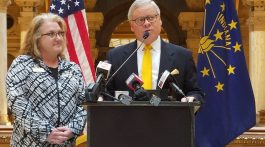
Attorney General Todd Rokita and Solicitor General James Barta entered the case as intervenor-defendants on May 1, alongside Alabama, Florida, Kansas, Louisiana, Missouri, Montana, Nebraska, Oklahoma, South Carolina, South Dakota and Texas. As previously reported, Rokita separately joined 12 other attorneys general in a July letter urging the Postal Service to adopt the rule.
In opposing the injunction, the intervenor states told Talwani they would be harmed by an order blocking their compliance with the rule, according to her opinion.
Missouri’s secretary of state filed a declaration saying that while his staff were still working through implementation, he believed compliance was possible by November. Talwani wrote that the declaration was too general to rebut what the other side filed. Election officials in half the states and the District of Columbia told her compliance was not feasible.
The court found the plaintiffs likely to win on claims that the rule is unconstitutional under the Elections Clause and beyond the Postal Service’s authority. Talwani wrote that disenfranchisement was “practically inevitable” if the rule took effect, and that the record contains no evidence of fraud in mail voting.
What Happens Next
The order does not stop states from following the rule voluntarily if their own laws allow it, and it does not reach elections after Nov. 3. Talwani denied the government’s request for a stay pending appeal and dissolved the temporary restraining order she entered Aug. 27.
The Justice Department had already gone over her head. Solicitor General D. John Sauer filed an emergency application with the Supreme Court on Thursday asking the justices to lift that restraining order, arguing the rule imposes only “modest envelope-design and addressee-information requirements” and regulates the mail rather than elections. Justice Ketanji Brown Jackson, who handles emergency appeals from the First Circuit, gave the challengers until Tuesday morning to respond.
What It Means Here
Indiana is one of 13 states that require a reason to vote absentee by mail, under a statute Talwani cites in the order. State law requires mail ballots be in the clerk’s hands by 6 p.m. on Election Day. Federal law requires ballots go to military and overseas voters at least 45 days out, which is Sept. 19 for this election.
In 2024, as previously reported, Rokita and Morales asked U.S. Citizenship and Immigration Services to verify the citizenship of nearly 600,000 registered Indiana voters. Morales later turned the state’s voter list over to the U.S. Department of Justice.