






by Bill Moreau
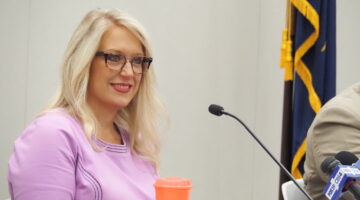
I was happy to accept my friend Rebecca Reeder’s invitation from Hoosiers United for the Separation of Church and State to lead a panel discussion at their 2nd annual Larry Hayes First Amendment Forum held recently in Fort Wayne.
The keynote speaker was Dartmouth Religion Professor and Episcopal priest Randall Balmer, author of “America’s Best Idea: The Separation of Church and State.” His presentation dissected and rebutted Christian nationalists’ revisionist version of American history. The redoubtable Sheila Suess Kennedy then engaged Prof. Balmer in a trenchant discussion.
Before starting my part of the program, I asked the engaged attendees to join me in singing a few lines of “God Bless America.” To my delight, most sang along loudly, smiling at my song choice.
“Okay everyone,” I said, “You’re now officially members of the choir!” Everyone laughed; they got it.
“So,” I said, “our conversation will try to get beyond ‘preaching to the choir.’ How do we get outside our own echo chamber?”
The five articulate, thoughtful Fort Wayne civic activists who made up the panel all agreed we need to engage with our fellow citizens who are not in our comfort zone.
On the drive back to Indianapolis, I finished the podcast I started on the way up and listened to two more.
As I pulled into the driveway, it hit me: “Way to go Bill, you just spent about seven hours inside your own echo chamber.”
Which explains why I was also happy to accept kind Abdul’s invitation to offer a guest commentary, based on the assumption it might be read by Hoosiers outside my echo chamber.
Is the separation of church and state on the ballot in November?
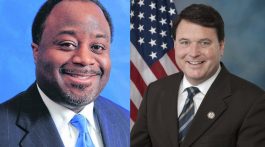
If you believe—as Lt. Gov. Beckwith and his fellow Christian nationalists do—that the principle of separation of church and state is a “myth,” you probably share their view that Hoosier public school students should be required to read the textbooks of a Texas publisher called WallBuilders, “the gold standard for learning the real history of America.” And if you do want to change the way American history is taught, you’re probably looking forward to electing likeminded school board members who’ll change the curriculum and the choice of textbooks. After all, Steve Bannon told us, “The path to save the nation is very simple—it’s going to go through the school boards.”
But how are you going to figure out which school board candidates share your views?
We’re here to help!
I’m the publisher of The Indiana Citizen. Since our launch in 2020, our nonpartisan 501(c)(3) has provided Hoosier voters an online, address-driven tool we call our Virtual BallotTM that will provide the names of every candidate on your ballot, linked to all the public information about each candidate we can find and link to their profile.
This year, for the first time in Indiana history—thanks to legislation actively promoted by Lt. Gov. Beckwith, passed narrowly by the General Assembly and signed into law by Gov. Mike Braun—school board candidates have the option of running as partisans. Supporters of the legislation repeatedly decried the way nonpartisan elections permitted “wolves in sheep’s clothing” to win school board seats.
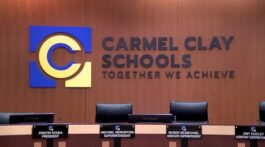
Statewide, 279 school corporations will elect 805 board members from among almost 1100 candidates.
We’ve figured out how to connect the school board candidates’ names to your Virtual BallotTM, but now comes the hard part: figuring out what they stand for. We’ve built a questionnaire for school board candidates that you find here. [link] Will you help us deliver it to your school board candidates?
Think how helpful it would be to know which school board candidates want our children to learn that the separation of church and state is a “myth.” Help us find the “wolves in sheep’s clothing.”