


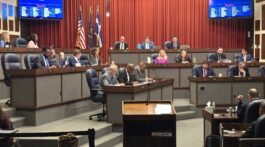








The Indianapolis City-County Council has approved a $1.9 billion budget for fiscal year 2027. The council’s Democratic majority describes it as a balanced plan focused on public safety and infrastructure. Republican leader Brian Mowery said the budget was “rubber stamped” without meaningful input.
According to a council news release, the budget does not draw on reserves for day-to-day operations. The release said it covers rising personnel and health care costs, reduced state-shared revenues and a state-mandated 22% increase in public safety pension contributions. It funds 1,743 police officers, 1,276 firefighters and additional 911 Center telecommunicators.
The budget includes about $267 million for roads, bridges and greenways and $39.2 million for stormwater improvements, which includes an additional $10 million for roads, the release said. The city also expects revenue from Proposal 192, the vehicle tax increase that took effect after the council overrode Mayor Joe Hogsett’s veto. With that revenue, the city projects more than $95 million in additional infrastructure funding in 2027. The council must still take separate action to appropriate the Proposal 192 money.
An accompanying bond package pays for a new IMPD North District facility and renovations to the Department of Public Works’ West Street Operations Garage. The budget also funds:
- Housing Hub operations, expanded shelter capacity and eviction diversion
- Behavioral health and opioid abatement programs
- An additional $2.1 million for parks
- Increased operating support for Animal Care Services
“This budget reflects our responsibility to protect essential services, invest in our neighborhoods and make every taxpayer dollar count,” Council President Maggie A. Lewis said in the release.
Mowery said the administration did not share information about the proposal with him until its formal presentation. He said representatives from the “25th floor,” a reference to the mayor’s office, met with council members in previous years to discuss district priorities, but those meetings have stopped. Mowery said he had heard promises in past years that future budgets would be handled differently. He said he had not seen amendments from the majority caucus spelling out the changes it wanted.
Mowery said the library’s budget did not give an accurate enough picture of its finances for the council to allocate funds properly. He said library representatives should have attended to answer questions raised in committee. He also objected to continued funding for the city’s DEI office, saying its functions should be handled by human resources. He called for more accountability from the Office of Public Health and Safety on how it uses its allocation.
Mowery said known costs, such as police vehicles, should be included in the budget. Leaving them out leads to requests for additional money during spring or fall fiscal sessions, he said. He said residents should not expect major service improvements. As an example, he said road funding would slow the rate of deterioration but would not eliminate potholes.
Mowery said the budget should keep taxes “relatively flat.” He noted that this assessment does not include the separately approved wheel tax increase. On potential state property-tax cuts, Mowery said predicted city funding losses had not happened as warned, and the city instead saw a funding increase. He said residents should not miss out on tax relief because of those predictions.
Mowery also questioned a recorder’s office proposal to spend money on anti-fraud advertising. He cited committee figures showing spending had increased 15-fold while engagement only doubled. That proposal was introduced at the meeting but was not part of the budget vote.
Assistant Majority Leader Andy Nielsen said the budget was developed through collaboration between the majority caucus and the mayor’s office, despite disagreements over some provisions. The mayor must still sign the budget, and the Indiana Department of Local Government Finance must still process it.
“The process doesn’t start and end,” Nielsen said. “It’s just a different point on the circle.”
Nielsen said he voted against the library budget. He said the library needs to provide clearer information on whether it is running a surplus or a deficit. “I am fully supportive of the library,” he said. He said that information will matter when local income tax arrangements are reviewed in 2028.
Nielsen said state law does not allow a budget to be increased after it has been introduced. Because of the timing of the two votes, Proposal 192 revenue could not be included in the 2027 budget. He said that money is expected to be appropriated through separate measures next year and folded into the base budget in 2028.

