


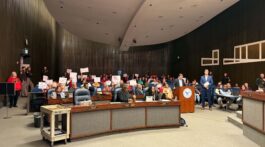








A $113 million tax abatement package for the DC Blox data center planned on Indianapolis’ east side failed 11-2 Monday before the City-County Council’s Metropolitan and Economic Development Committee.
Proposals 345 and 346 would have approved the personal and real property statements of benefits for DCB Indianapolis, LLC, which does business as DC Blox. Indy Economic Development Inc. valued the package at $113 million over a 10-year abatement period. Councilor Michael-Paul Hart, R-District 20, sponsored the measure.
The company’s filing lists a site at 305 Fintail Drive in the Thunderbird Commerce Center, the former Ford plant site. It describes a potential two-phase project: a 70,000-square-foot, 10-megawatt data center, followed by a possible 250,000-square-foot, 40-megawatt facility. The filing estimates $384 million in real estate improvements and 21 new jobs.
Councilor Andy Nielsen, D-District 14, said the county’s data center policy remains unsettled while officials consult experts, industry representatives and the public. He said any data centers ultimately approved should pay their fair share rather than receive incentives that limit their tax contributions. Before the vote, Nielsen told WTHR that if DC Blox builds the project, “they should be paying full sticker.”
Nielsen also said land-use decisions and tax incentives should be considered together, saying separate processes make government harder for residents to follow.
He said nearby residents had not supported the project and had raised concerns about a large development near their homes. He said the site has hosted other industrial projects without similar controversy and that he hoped a future use could bring jobs and tax revenue with more community support.
The project’s community commitments grew from $15 million to $30 million during negotiations, according to supporters, who credited Nielsen with negotiating the higher figure. Nielsen did not commit to supporting the project. Indy Economic Development had earlier put the community inclusion payment at about $28.5 million, including $5.7 million for Washington Square Mall redevelopment and $2.5 million for workforce development.
Council member Michael Paul Hart, a project supporter, called the outcome a lost opportunity for the east side, saying the development could have become one of the city’s largest taxpayers. He said the property would generate about $37,000 a year in property taxes without the development, and that revenue would be materially higher if both buildings were built. He said the community payments were tax revenue, not an effort to “buy off” schools or parks.
Hart made a similar argument in his newsletter Sunday, writing that the site is already zoned for a data center and that DC Blox would build the first building regardless. With the abatement, he wrote, the company builds both buildings and the city and surrounding community receive about $57 million over 10 years.
The supporter said the vote could make Indianapolis look less welcoming to investment, saying large industrial projects are increasingly locating outside the county, including near 96th Street. He tied the need for recent tax measures and referendums to what he described as insufficient business investment in Marion County.
Nielsen rejected the idea that the vote makes the city anti-development. He said residents asked officials to slow down and get the decision right, and that the county continues to see investment.
The property remains zoned I-3, which the supporter said allows a range of industrial uses, including chemical manufacturing. He said the proposal is not necessarily dead before the full Council’s scheduled Dec. 7 vote and urged DC Blox to keep meeting with community organizations.
The package requires Council approval because the site lies in the Irvington Plaza-Brookville Road tax-increment financing district. Irvington Community Schools and an east side community group are suing to stop the data center, the IBJ reported.
The project was approved before the city’s moratorium on new data centers, which runs through Dec. 31, 2027. City planning staff have said previously approved projects are effectively grandfathered. Mayor Joe Hogsett can approve or veto the Council’s resolution.

