







(Apologies to the 90s band Nine Days, and to everyone who will now have that song stuck in their head until June 20. You’re welcome.)
by Abdul-Hakim Shabazz, Esq.
Nine days from now, roughly 1,800 Republican delegates will file into the Grand Wayne Convention Center in Fort Wayne and decide whether Diego Morales gets to keep his job on the November ballot. And if you’ve ever seen Mad Max Beyond Thunderdome, you know exactly what’s about to happen. Four candidates enter. One candidate leaves. The chainsaws are metaphorical. Mostly.
Let’s begin, shall we.
The Warm-Up Act
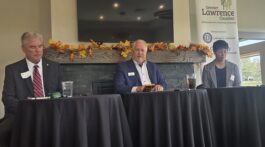
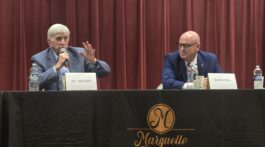
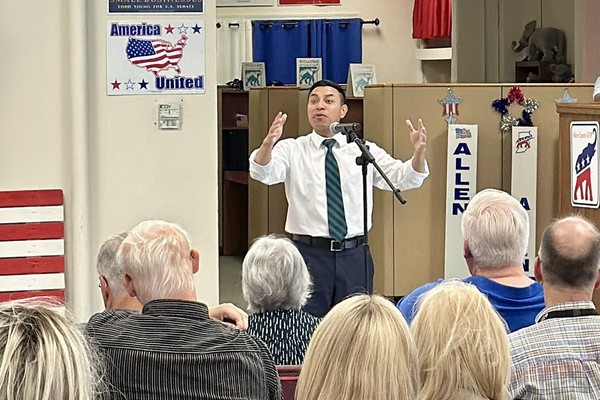
Earlier this week, a delegate meet-and-greet popped up on the calendar in Allen County — the convention’s host county, which means the people in that room will barely have to find parking to vote next week. The statewide candidates spoke. Your humble, just kidding, correspondent has talked with multiple people who were in the room, and their accounts line up.
Here’s how it went.
The Treasurer and the Comptroller did what officeholders with no scandals do: gave their speeches, hit their marks, sat down. Riveting stuff. Democracy in action.
Then the Secretary of State got up.
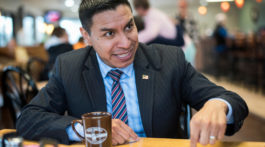
According to the people in that room, Morales spent his time defending his office against what he called fabricated attacks — including the hiring of a deputy chief of staff who, as this publication first reported, was not a United States citizen and carried a non-citizen restriction code on her BMV record. He explained, at some length, that it is not illegal for a non-citizen to work in state government.
Which is true! It is also completely beside the point. Nobody — not this publication, not the delegates, not the senior Republicans who have spent the past month sprinting away from his campaign — ever claimed the hiring was illegal. The question, the one that has been sitting on the table since the story broke, is how a non-citizen ended up in a senior position in the office that runs Indiana’s elections, and what kind of vetting produces that result. On that question, attendees say, the Secretary of State gave the room nothing.
Defending yourself against a charge nobody made while ignoring the one everybody did. That’s not a defense. That’s a tell.
The Counterpunch
Now, it happens that the man whose office sits directly across the hall from the Secretary of State was also on the program. And State Treasurer Daniel Elliott, who has roughly the political subtlety of a tire iron and is weirdly proud of it, decided to address the elephant (pardon the GOP pun) in the room.
Elliott confirmed his remarks to me afterward. He told the crowd that his own grandmother, who raised him, was a non-citizen — “but my grandmother wasn’t overseeing elections in Indiana either.”
He let that sit for a second. Then he kept going. He pointed out that he drives a base-model fleet truck. He asked the delegates how many no-bid contracts worth $80,000 or more his donors hold with the Treasurer’s office, and supplied the answer himself: none. He did not have to explain the references. Everyone in an Indiana Republican delegate meeting in June of 2026 can fill in those blanks without a study guide.
I’m told delegates clustered around Elliott afterward with questions, two and three deep. Make of that what you will. I know what I make of it.
One more thing Elliott told me, and this one matters. The Morales camp has been pushing a narrative to delegates that all of this — the Kupce story, the endorsement withdrawals, the criticism from fellow officeholders — is one coordinated operation run out of Jim Banks’s shop. I asked Elliott about it. He says he had exactly zero conversations with Banks or Todd Rokita before putting out his own statements. “There’s no massive conspiracy behind the scenes,” he told me. “These are all people making their own independent decisions.”
Sometimes, folks, a cigar is just a cigar.
Where the Bodies Are Moving
Here’s what the Republicans actually working delegates — by phone, at picnics, at these meet-and-greets multiplying across the calendar like dandelions — are telling me, and the consistency is striking: the movement in this race runs one direction, and it is away from the incumbent.
David Shelton’s people, built over more than a year of the Knox County Clerk grinding through delegate phone calls, are described as locked in. Not moving. The delegates peeling off Morales are splitting between Max Engling — the Banks adviser who parachuted in last month with the senator’s endorsement in his luggage — and an undecided bloc whose only firm conviction is “not Diego.” What nobody, anywhere, is describing: delegates flowing back to the incumbent.
Jamie Reitenour keeps her base in the activist wing, and in a multi-ballot convention — which this could easily be — where her delegates land matters a great deal.
Now, the standard disclaimer, which I will administer to myself so you don’t have to: the people working these rooms have rooting interests, and delegates who seek out the incumbent’s critics are not a scientific sample. Fine. Noted. But when sources backing different candidates all describe the same traffic pattern, that’s not spin. That’s a map.
Meanwhile, In Your Text Messages
Of course, the candidates aren’t the only ones working the delegates. Somebody else has their cell numbers, and delegates have been forwarding me the results, with commentary ranging from “annoying” to considerably saltier.
Two specimens have crossed my desk. They are not the same animal.
The first, from an unfamiliar 317 number, goes after “Dangerous Diego Morales” by name — the non-citizen top aide, the $160,000 taxpayer salary, the warning that nominating him June 20 gift-wraps the office for the Democrats. Harsh? Sure. It’s also just politics. The factual spine tracks reporting this publication did first, and it carries the legally obligatory fine print: “PAID FOR BY SAVING AMERICA’S FUTURE, INC. NOT AUTHORIZED BY ANY CANDIDATE OR CANDIDATE’S COMMITTEE.” The real question about that one is who on earth Saving America’s Future, Inc. is — an outfit confident enough to text 1,800 convention delegates but shy enough to have essentially no public footprint. We’re looking. There is a certain poetry in the fact that corporate registrations in this state get filed with — wait for it — the Secretary of State.
The second text is the one that requires us to talk.
It arrives from an 812 number wearing a Simpsons meme — Homer telling Bart, “You’re being replaced by legal immigrants.” Then: “GOP Delegate, Did you build up this state for foreigners, or for your kids? Since 2019, 75% of new jobs have gone to immigrants, not Hoosiers. Your children’s wages are being depressed to prioritize foreign labor. It’s time to fight back” — followed by a link to sign a “Save Heritage Indiana Action” platform amendment. And unlike two years ago, the platform is live business in Fort Wayne, because midterm conventions are when the party revises it.
Notice what that message is not about: any candidate, any scandal, any Hummer. It is a message to the people who write the Indiana Republican Party’s statement of principles, informing them that their problem is foreigners taking what belongs to their children. The statistic comes with no source and no Indiana data. The message comes with no disclaimer at all. Apparently the first outfit’s lawyer never got a look at the second outfit’s copy.
The great Molly Ivins, reviewing Pat Buchanan’s culture-war speech at the 1992 Republican convention, observed that it probably sounded better in the original German. I’ll go one further. This one would have sounded better in the original German with “Tomorrow Belongs to Me” swelling in the background of the biergarten — excuse me, beer garden. If you know the scene from Cabaret, you know the moment: sunshine, a fresh-faced tenor, everyone joining in verse by verse, and the camera pulling slowly back while you realize what it is you’re actually watching.
Now here’s where it stops being merely gross and becomes a story. Save Heritage Indiana is not hard to find. Its website declares a mission to “stop and reverse mass migration” to preserve Indiana’s heritage. And its endorsement page features, among sitting legislators, a testimonial from the Lieutenant Governor of Indiana, warning that “our culture is being stolen right out from underneath our eyes.” So when that platform amendment reaches the floor in Fort Wayne, every delegate and every officeholder standing nearby will be voting on whether this is what the Indiana Republican Party sounds like now. That vote may tell us more about the party’s direction than anything in the Secretary of State’s race.
Two questions on behalf of every delegate whose phone keeps buzzing. The delegate list is party property. Who handed it to these people? And is anybody at headquarters the least bit curious?
Because here’s some free intelligence for the senders: it’s backfiring. The delegates forwarding me this stuff are not squishes. They’re committed convention Republicans, and their reaction runs from eye-roll to disgust. “It used to be an Indiana thing,” one told me. Delegate contact used to mean a candidate, a phone call, a county chair you’d known twenty years. Now it’s anonymous shortcodes asking whether you built this state for foreigners.
Why None of This Is Over
And yet none of it is settled, because conventions don’t work like anything else in American politics. The smart-money crowd keeps forgetting that.
A primary is an air war. Whoever has the most money carpet-bombs the district and goes home. A convention is the last bastion of pure politics left on Earth — apologies to the Duke brothers — a room where eighteen hundred people who actually read the mailers can still be persuaded, in real time, by a human being making an argument. The speeches matter. They are practically the only place left where they do.
Don’t believe me? The Democrats just ran the experiment. Beau Bayh’s 61-39 win at their convention this month included a real bloc of delegates who walked in undecided and got moved in the hall. Republicans wrote their own case studies: two years ago, delegates looked at Mike Braun’s hand-picked lieutenant governor and chose Micah Beckwith instead. And four years ago, a convention floor took the nomination away from a sitting Secretary of State named Holli Sullivan and handed it to a hungry underdog named — say it with me — Diego Morales.
The lesson of all three, which the anonymous texting brigades might want to laminate: the most informed eighteen hundred Republicans in Indiana do not like being told what to do. And they especially do not like being told by people who won’t sign their texts.
Which brings us to the punchline. The one man in this field who needs absolutely no tutorial on how a convention strips an incumbent is the incumbent. He wrote the textbook. Now it’s being used on him.
Morales walks into Fort Wayne unable to vote for himself — he and his wife both lost their delegate races in May. He walks in shorn of the endorsements of Indiana’s senior senator and its attorney general. And he walks in, based on what the host county’s delegates watched this week, still litigating the story instead of answering it.
He has one speech left to change all of that. Indiana convention history says one speech can be enough — in either direction. He’s the proof.
Nine days. This is the story of a Secretary of State — and, increasingly, the story of what the Indiana Republican Party wants to sound like. In any language. Whether it ends with the chorus or the fade-out is, for once in modern politics, genuinely up to the people in the room.
The winner gets Beau Bayh and Libertarian Laura Shillings in November, with Greg Ballard still gathering signatures for an independent run out on the horizon. But that’s the next verse. First, Fort Wayne.
And Diego — you know the number. The line is open, and so is the question.
In the meantime, the Secretary of State may be telling himself this is less Thunderdome and more Hunger Games, hoping the odds will be ever in his favor. We doubt it. But this is an Indiana convention, where anything is possible. He’s the proof of that, too.
— Abdul-Hakim Shabazz is the editor and publisher of Indy Politics. He is also an attorney licensed in Indiana and Illinois