


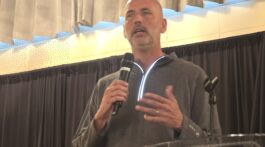







Indianapolis City-County Councilor Michael-Paul Hart is defending his opposition to a recently approved wheel tax increase, arguing city leaders failed to seriously pursue spending cuts or accountability measures before asking residents to pay more.
In an interview reviewing a busy week at the City-County Building, the Republican councilor from District 20 said constituent feedback and structural concerns with the proposal led him to vote against the measure, which passed the council 14–10.
Hart said he was troubled that city officials openly acknowledged in committee hearings they had not explored reducing spending before seeking higher taxes for road funding.
“Have you looked to reduce spending? And we got a blatant answer: no,” Hart said. “That just made it really hard to support something.”
Under the plan, the wheel tax increase is tied to a five-year state matching program. Hart criticized the council majority for making the tax permanent even though the state match expires after five years. He also questioned the flat $100 rate on consumer vehicles, saying lawmakers should have considered indexing the amount annually to match actual funding needs rather than locking in a fixed figure.
Supporters of the tax have argued that paying more up front for road maintenance can help residents avoid higher repair costs later, framing it as a choice between a wheel tax bill and a new tire or alignment. Hart acknowledged that for drivers with a single vehicle, that comparison can be compelling. But he noted many households own multiple cars, trailers, or boats, multiplying the impact and turning an $80 increase per vehicle into several hundred dollars a year for some families.
Hart also addressed criticism that Republicans helped create the road funding tool at the Statehouse but opposed its use locally. He said Democrats rejected GOP suggestions to time-limit the tax, pursue cost savings first, or adopt an indexed structure that would raise only what was needed each year.
“When you’re trying to get support from another group of people, you would expect to give them something in return,” Hart said, arguing that none of the Republican ideas were seriously entertained.
Beyond the wheel tax, Hart expressed frustration over the council’s handling of public safety and accountability issues.
He pushed a proposal to extend curfew enforcement to 17-year-olds during designated public safety periods, citing recent incidents involving juveniles, including a 17-year-old homicide victim after midnight and groups of teens involved in gunfire and curfew violations around the July 4 holiday. The measure passed committee but was ultimately voted down by the full council.
Hart said Indianapolis Metropolitan Police Department leadership supported the idea as a way to prompt more conversations between parents and teenagers about late-night activity, and to give officers another tool to intervene before more serious crimes occur. He argued Democrats were not taking juvenile crime seriously by rejecting the change.
Hart also sponsored a measure targeting the Office of Public Health and Safety following a critical city audit. The audit, he said, found roughly $45 million in funds that could not be properly accounted for, despite a 78 percent budget increase in recent years. His proposal would have required the office to show proof of standard procedures, payment records and program effectiveness before receiving its 2027 funding.
The proposal initially advanced out of committee but failed on a party-line vote at the full council meeting after Democrats declined to separate the accountability requirements from the potential future funding freeze.
Looking ahead to the 2027 municipal elections, Hart predicted the wheel tax vote and the OPHS audit could become key campaign issues. He said his focus is not on a mayoral bid but on recruiting and supporting more Republican candidates for the council.