











by Mackenzi Klemann, Indiana Capital Chronicle
August 18, 2026
Members of the Indiana Black Legislative Caucus say Gov. Mike Braun overstepped his authority when he issued an executive order last month targeting a state diversity program.
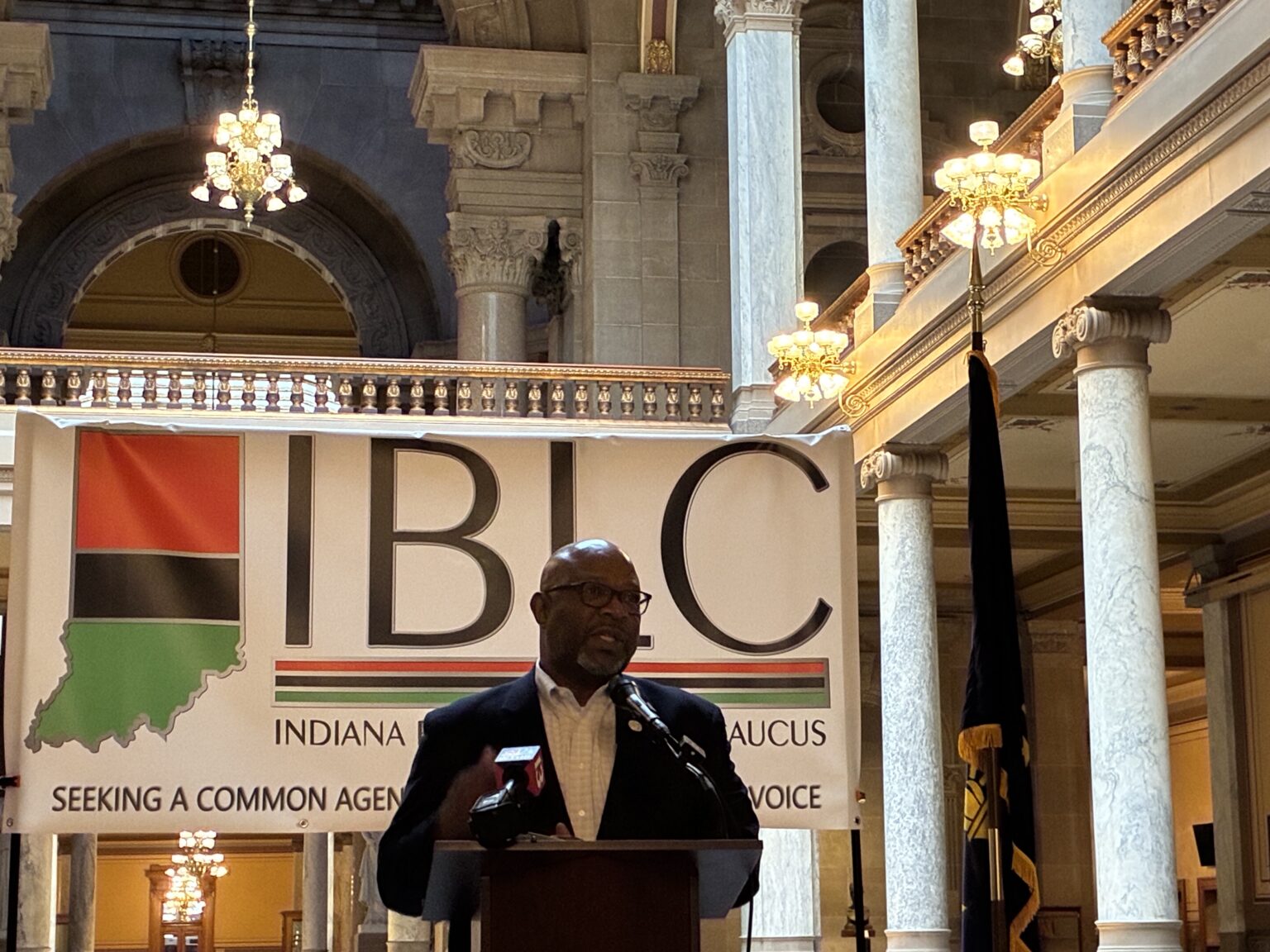
The IBLC hosted a press conference Monday to renew attention to the order eliminating race- and sex-based preferences in the Minority and Women’s Business Enterprises Program without legislative approval — calling on affected businesses to come forward as the caucus investigates the economic and legal ramifications of the order.
Braun relied on a non-binding advisory opinion by Attorney General Todd Rokita, which found the program unconstitutional, to ignore a 1983 law establishing the program.
“If the governor wants to change the law, the governor should run for state representative or state senate,” said Sen. Greg Taylor, D-Indianapolis, a member of the caucus. “He is the executive. The executive branch is to execute the laws of the state of Indiana.”
He added, “To determine whether or not a statute is constitutional, you have to go through a court proceeding.”
Lawmakers created the minority enterprise program to improve equitable distribution of state contracts.
The Governor’s Commission on Supplier Diversity studies disparities in the state procurement system, setting participation goals to make the process more equitable.
The commission then encourages contractors owned by minorities, veterans and women to participate in the bidding process by including them in a mailing list and other initiatives.
All contracts remained subject to competitive bidding, said state Rep. Earl Harris Jr., D-East Chicago. “The goal was to make sure qualified businesses had an opportunity to compete,” he said.
“We never got a hand out,” said Anita Williams, co-founder and program director for the Indy Black Chamber of Commerce.
Braun canceled a minority business exposition and diversity study last year to allow Rokita to conduct a legal review of the program, resulting in last month’s executive order.
The governor will establish a merit-based procurement system in its place.
In a press conference last month, Rokita described the program as “blatantly illegal” favoritism, calling it and an “insult” to suggest minority and female business owners “cannot compete on a fair playing field.”
His opinion references the U.S. Supreme Court’s 2023 decision in Students for Fair Admissions v. Harvard, which found racial preferences in college admissions violates the 14th Amendment.
Still, Taylor said the caucus believes the minority enterprise program “passes constitutional muster,” citing a 2003 case permitting similar remedies for past discrimination.
“This is not about being admitted into college,” he said. “This is about remedying past discrimination in business contracts.”
Representatives from the Indy Black Chamber of Commerce, the National Association of Women Business Owners and the Indianapolis Urban League joined Taylor and other IBLC members at the Statehouse Monday.
Tony Mason, president and chief executive officer of the Indianapolis Urban League, questioned what criteria the state will use for its new merit-based system.
“Who have you sought input from?” he asked.
The state procurement system should be “competitive, transparent, data-driven and open to every qualified business,” Harris said.
“If the administration believes its new approach is better, then show us the data,” he said.