





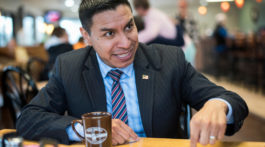

Between storms, shifting tax policy, and fights over economic development, Indiana’s cities and towns are standing at a major crossroads. That’s the assessment of Matt Greller, head of Accelerate Indiana Municipalities (AIM), who says local governments are being asked to do more while the ground under their main revenue sources keeps moving.
In a recent conversation with Indy Politics, Greller said the severe weather that’s pounded the state this summer – from hurricane-force winds in northwest Indiana to historic flooding in east central Indiana – has been a blunt reminder of what local government actually does.
“There is a lot of damage,” Greller said, noting that NIPSCO reported the largest outage event in its history after winds topping 100 miles an hour hit the northwest corner of the state. Communities are dealing with downed trees, wrecked infrastructure, and thousands of residents left in the dark.
One thing, he says, has worked the way it’s supposed to: cities and towns helping each other. Greller pointed to places as far south as Washington, Indiana sending electric crews north to help restore power. “We put the word out for folks if they need help to ask their brothers and sisters in other areas of the state that were not impacted,” he said, and local governments answered the call.
But the people and equipment that respond in those moments don’t come free.
“Those things cost money to provide,” Greller said, adding that everything from fire trucks to wages is “a heck of a lot more expensive than they were just a couple of years ago.” And that’s where Indiana’s running debate over taxes and revenue has him worried.
Wheel Taxes, Gas Taxes, and Sticker Shock
You’re hearing more about the wheel tax these days, and Greller says that’s no accident. For years, cities and towns over 5,000 in population have been allowed to pass their own local wheel tax. What’s changed is the incentive structure at the Statehouse.
Lawmakers created a new lane-miles distribution formula that sends extra state money to communities that adopt a wheel tax, on top of what they already get from the gas tax. That’s pushed a lot of councils to sharpen their pencils.
“A lot of communities have done the math and run the numbers to determine whether or not it makes financial sense for them to pass it,” Greller said. The decision is part spreadsheet, part politics – in an era “where everybody’s paying more for everything,” local officials know they’re asking for a tough sell.
Nowhere has that been clearer than in Indianapolis, where the council passed a wheel tax, the mayor vetoed it, and the council promptly overrode the veto. Greller isn’t jumping into that particular food fight, but he says AIM’s broader position is simple: let locals have the tools and “make the best decisions locally.”
On the gas tax, Greller gives Gov. Mike Braun credit. The governor has now suspended part of the tax three times this year under energy emergency declarations to help motorists, raising questions about what that does to road funding. Greller said the administration has made local governments whole on the first two suspensions and has told AIM the third will be handled the same way.
“The governor is pro-infrastructure,” Greller said, and so far has “delivered on replacing that lost revenue.”
The Big Wild Card: Property and Income Taxes
The real uncertainty, Greller says, sits with property taxes and local income taxes, which together make up the lion’s share of city and town budgets.
Right now, 45 to 70 percent of local revenue comes from property taxes, depending on the community, with most of the rest coming from local income taxes. Recent changes in Senate Enrolled Act 1 created new credits and exemptions that lower what local governments and schools actually collect. That’s just phase one.
Phase two is the growing list of proposals at the Statehouse that would go much further – up to and including eliminating most property taxes and replacing them with an expanded sales tax on services, carving out special breaks for seniors or people who’ve paid off their homes, and a complicated “rate cap” system that would shift who pays what, and where.
“You move any part of [the system], it has downstream impacts that most, save for maybe four or five people in the entire state, can fully understand and model out,” Greller said. Lawmakers, he notes, are getting hammered by homeowners who write big checks twice a year and want relief, but the fixes are anything but simple.
At the same time, changes in how local income taxes are administered and distributed are shifting more control to counties. In theory, that could be fine. In practice, Greller says, at least 70 communities are on track to receive “far less” unless their counties step in and deliberately protect their existing shares.
“All those things together make for a very uncertain fiscal outlook for cities and towns,” he said. When you don’t know what your two main revenue streams will look like, it’s hard to plan a major project, let alone put an incentive package on the table and promise a company what you can deliver 10 or 20 years down the road.
Data Centers, AI, and Quality of Life
If you want a case study in how these issues collide, look at data centers. As Greller puts it, everyone loves the data; not everyone loves the data center.
He says the projects are deeply polarizing at the local level, but when they’re structured right, they can be “transformational.” He points to a massive data center in Hobart that’s expected to generate significant new revenue and take pressure off homeowners, as well as smaller projects that reuse brownfield sites or come with commitments to help fix aging sewer systems.
AIM, he says, is trying to get past rumor and emotion and focus on educating communities so they can make informed decisions about land use, incentives, and long-term impacts.
On the tech front, artificial intelligence is already here, even if it’s not always visible. Greller notes at least one city used AI last winter to map snowplow routes in seconds – work that would otherwise have taken staff hours. He expects AI to push deeper into budgeting and economic development work, calling it “fascinating and scary all at the same time.”
Underneath all of this is a bigger question: can Indiana keep investing in quality of life – the parks, trails, and amenities that actually get people to move to a community in the first place?
For the last decade, programs like Regional Cities and READI have helped cities and towns build the kind of places companies want to send jobs to, and workers want to live in. Greller worries that an unstable tax and revenue structure could force local governments to fall back to the bare minimum.
“We have to make sure the police and fire are paid,” he said. “We have to make sure our utilities are operating.” But once you cover the basics, he fears, there may not be enough left to keep building the kinds of communities that can compete.
“That is my number one concern,” Greller said – that in trying to fix the tax system, Indiana could “undo all the good we’ve done” on quality of life and economic development over the last 10 to 12 years.