



by Abdul-Hakim Shabazz, Esq.
My Republican friends, I come in peace. Put down the pitchfork, pick up your phone and hear me out.
I spent part of a Sunday morning doing something nobody should do before coffee: counting Facebook followers for the county political parties in the doughnut around Indianapolis. What I found shouldn’t keep you up at night. But it should at least make you check your notifications.
In Hamilton County, the Democratic Party’s Facebook page has 6,200 followers. The county GOP has 4,300. In Hendricks County, it’s 2,500 Democrats to 1,900 Republicans, and the Democrats have posted more than twice as often, 3,200 times to 1,500. In Hancock County, it’s 2,700 to 2,100. In Boone County, it’s 2,400 to 1,900.
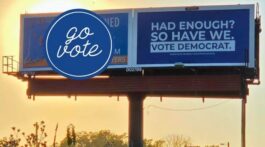
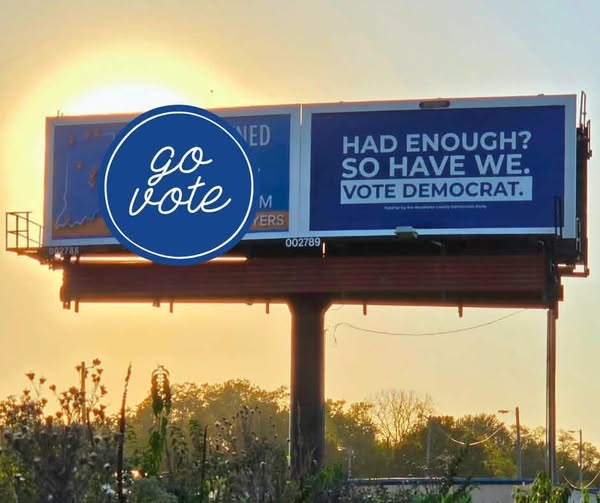
Add it up and the Democrats lead 13,800 to 10,200 across four counties where, on Election Day, Republicans usually win by margins that make the counting a formality. Hendricks Democrats have gone analog too, with a billboard that reads, “Had enough? So have we. Vote Democrat.”
Now, before anyone at a Lincoln Day dinner chokes on the chicken: social media does not vote. Need proof? The Indiana Democratic Party has 53,000 Facebook followers. The Indiana Republican Party has 37,000. Republicans hold every statewide office and supermajorities in both chambers of the General Assembly.
Facebook followers don’t stand in line at the fire station. Some of them don’t live in the county. Some are reporters like me, the least useful voting bloc in Indiana. And when you’re the minority party in a one-party county, the Facebook page is the clubhouse, the place you find out you’re not the only Democrat on your cul-de-sac. Republicans in Danville, Greenfield and Lebanon don’t need a support group. They have the courthouse.
So, Republicans, you are not losing the doughnut.
But.
If you think social media doesn’t matter, ask Barack Obama. In 2008, a first-term senator with what he called a funny name used Facebook, email lists and online organizing to build a volunteer army and a small-dollar fundraising machine that beat Hillary Clinton in the primary and John McCain in November. Or ask Donald Trump. In 2016, he spent a fraction of what Clinton did on television, took his message straight to his followers on Twitter, bought Facebook ads by the truckload, and went from punchline to president. Social media doesn’t vote. But it helped elect two of them.
I’ll admit something else. I’ve covered Indiana politics a long time, and I usually trust the numbers over my gut. This year, I feel a disturbance in the Force. It’s a midterm with a Republican in the White House, which historically isn’t kind to the president’s party. A redistricting fight turned Republican senators against each other. A former Republican mayor is running for Secretary of State on a third-party line. And voters are grumbling about property taxes, gas prices and the cost of just about everything. None of that shows up in a voter registration report. It does show up in who bothers to click.
Hamilton County is the cautionary tale. Everybody said this stuff didn’t matter there, right up until the margins started shrinking. That shift showed up first as energy: volunteers, yard signs, people who cared enough to come to a meeting, or at least click “follow.” In a midterm, attention is turnout.
The good news for my Republican friends is that the fix is easy and cheap. Post something. Knock on a door. Buy a billboard of your own. Remind your voters there’s an election, because the other side is reminding theirs. Nov. 3 will tell us whether all those likes were a wave, or just a wave hello.
Abdul-Hakim Shabazz is the editor and publisher of IndyPolitics.org and an attorney licensed in Indiana and Illinois. He finished second in the 2023 Indianapolis Republican mayoral primary, so he knows social media doesn’t vote.