


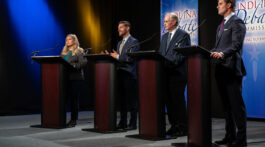




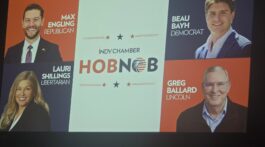

All four candidates in Indiana’s secretary of state debate said the current office should face scrutiny, but they split over how that review should happen: through law enforcement, the state Inspector General or an audit.
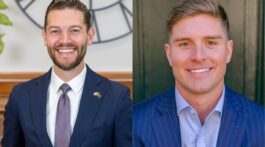
Former Indianapolis Mayor Greg Ballard called for law-enforcement investigators to examine the office. Republican nominee Max Engling said the Inspector General should lead the review. Libertarian Lauri Shillings called for a strict audit of the office’s budget, while Democrat Beau Bayh said he would pursue an independent review and work with law enforcement if evidence of possible crimes emerged.
Candidates differ on investigation
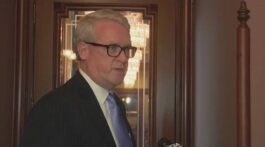
“I believe in the law-enforcement people that I’m talking to, and I think we need to start at that point,” Ballard said in a post-debate media interview. “If there’s nothing in there, criminal, fine. But they’ll tell us that.”
Ballard said he had spoken with former law-enforcement officials and believed investigators should be involved from the outset. He argued that the office needed to be cleaned up and public trust restored, citing his experience as Indianapolis mayor.
Engling said the Inspector General is independent and responsible for examining state offices, identifying problems and determining how to address them. He questioned whether an audit paid for by a candidate could truly be considered independent, and said the Inspector General should decide whether findings warrant a referral.
“I would say we’re looking at an independent Inspector General,” Engling said. “They would conduct an audit, and then they would say, ‘What are the issues?’”
Bayh criticized Engling’s reliance on the Inspector General. He cited concerns about purchases of luxury SUVs, no-bid contracts, travel and the hiring of relatives, and said the Inspector General had examined those matters for two years without taking action. Bayh said he would take the initiative to uncover problems and work with law enforcement if evidence of potential criminal wrongdoing emerged.
Shillings said a strict audit should determine what the office spent and whether expenditures were approved. Asked if the matter should be escalated to a criminal investigation, she said, “If the evidence supports it.”
The candidates’ comments came amid criticism of spending and hiring practices in the office. Their assertions about those matters were not independently verified during the interviews.
Bayh also accused Engling of not committing to an independent audit, to barring campaign donors from receiving contracts from the office, or to avoiding individual-stock trading while serving as secretary of state. Engling disputed Bayh’s characterization of his investments, saying he owned four individual stocks worth about $40,000, based on public reporting. He also raised questions about stock ownership by Bayh’s father, a former U.S. senator.
Dispute over voter eligibility
The candidates differed over how to characterize the risk of noncitizens voting and what safeguards are needed. Shillings said Indiana already has checks to verify citizenship when people register to vote. She criticized the federal SAVE Act, arguing its documentation requirements could make registration harder for eligible voters who cannot readily obtain records matching their current names.
Shillings said the requirements could burden people who are adopted or have married or divorced, and potentially require them to pay for documents or visit a clerk’s office in person.
Engling said the state must ensure that only eligible citizens vote. He cited a December 2025 report that he said identified 165 people illegally on voter rolls and 21 who had voted illegally. “Even one instance of illegal voting is too many,” he said.
Bayh cited an investigation by the secretary of state and attorney general that he said identified 22 instances of voter fraud among millions of votes cast. He said he would work with law enforcement and the attorney general’s office to pursue cases when appropriate, and questioned why those cases had not resulted in prosecutions. The candidates cited different figures and descriptions of voter-fraud cases during the interviews.
Ballard said he was not overly concerned about the security of the coming election, pointing to the work of Indiana’s 92 county clerks and their cooperation across party lines. He nevertheless called for more standardized training for election officials statewide, while allowing for local needs.
Candidates propose different responses to AI
Artificial intelligence also featured in the candidates’ proposals. Shillings said election systems need regular testing and patching to keep pace with cybersecurity threats. She proposed assigning staff to monitor election security or partnering with a trusted vendor.
Ballard said the state should consult universities and businesses as it prepares for threats such as deepfakes, adding that officials do not yet know how best to address the rapidly changing technology.
Bayh said he would use AI as a predictive tool to identify potential securities fraud and educate older adults and other vulnerable groups about deepfakes and scams involving large language models.
Engling proposed using AI to analyze business filings and identify suspicious patterns, such as multiple apparently fraudulent limited liability companies operating from one address. He also cited title and deed fraud involving people impersonating notaries and said he would consider adding a specific crime for notary impersonation.
Proposals to increase voter participation
The candidates also offered differing proposals to increase voter participation. Shillings said the state should modernize its voter-information website, assess its usability and links, and make information easier to access on phones and computers. She proposed voting centers in select areas where certified election workers could assist people with mobility challenges who missed the opportunity to vote absentee.
Shillings said she supports Indiana’s current rules requiring voters to qualify for an absentee ballot under one of the state’s listed reasons. She said those who meet the requirements, including people with mobility limitations, should be able to apply. She also said the Libertarian Party hopes to win 10% of the vote to gain major-party status and access to primaries. Shillings said she was polling at 6% and described her campaign as focused on digital advertising, radio and social media.
Bayh called for ending straight-ticket voting and allowing citizen-led ballot initiatives. He argued that more political competition would improve accountability and give voters a more direct role in policy decisions.
Engling said straight-ticket voting is a choice for voters and that changing the rules is up to the legislature. He opposed citizen-led initiatives, arguing that wealthy groups could use them to bypass elected lawmakers and spend heavily to promote ballot questions.
Ballard supported providing voters with a guide, in print or through an app, to explain ballot questions, including constitutional amendments. He rejected concerns that a guide would be too expensive, saying voters he had spoken with supported the idea.
The candidates agreed that the office’s practices warranted examination, but offered different paths forward: Ballard wants law-enforcement investigators involved at the outset; Engling would leave the review to the Inspector General; and Shillings and Bayh called for audits or independent reviews.