
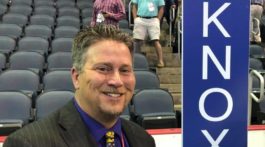

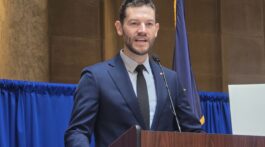





Knox County Clerk David Shelton, the Republican who filed a campaign finance complaint against GOP Secretary of State nominee Max Engling in July, has surfaced this week in the campaigns of two of Engling’s opponents.
On Wednesday, Democratic nominee Beau Bayh announced that if elected, he plans to have Shelton oversee the independent audit of the Secretary of State’s office that Bayh has promised since launching his campaign. Separately, Shelton filed an amicus curiae brief supporting Lincoln Party candidate Greg Ballard’s lawsuit to force the Indiana Election Commission to meet.
The audit
In a news release, Bayh said Shelton would help develop requests for proposals, review bids and findings, and recommend next steps on potential wasteful spending. Bayh cited spending under the current Secretary of State, including luxury SUVs, hiring relatives, millions of dollars in no-bid contracts to campaign donors, and unexplained foreign travel.
“Bringing a respected Republican into this process sends a clear message – protecting Hoosier taxpayers is not a partisan issue,” Bayh said.
Shelton said in the release that his involvement is not an endorsement.
“I remain a proud Republican, and this is not an endorsement of Beau’s campaign, but I welcome his commitment to conducting an independent audit of this office,” Shelton said. “If the Republican candidate would commit to the same pledge, I would be happy to join him in the effort.”
Shelton is in his eighth year as Knox County Clerk. According to the Bayh campaign, he has been a licensed private investigator for nearly 30 years.
The lawsuit
Ballard’s suit, Ballard v. Indiana Election Commission, is pending in Marion Superior Court 3. It asks the court to order the Commission to convene and decide pending campaign finance complaints before the Nov. 3 election. A hearing on Ballard’s motion for a preliminary injunction is set for Friday at 11:30 a.m.
Shelton filed his brief on his own behalf Tuesday evening. In it, he says the Commission has not met since July and has scheduled no meeting. He also says his complaint has been pending for 88 days.
The brief lists four pending complaints. Two concern the Engling campaign: Shelton’s July 24 complaint, and a Sept. 15 complaint asking whether a Hoosier Leadership for America event the night before the state convention, where Engling was billed as a “special guest,” was an unreported in-kind contribution. The other two concern Bayh’s campaign. The brief does not describe them.
Shelton’s complaint alleges that the Engling campaign accepted a $60,000 contribution on June 30 from Hoosier Leadership for America Inc., a nonprofit corporation that does not disclose its donors. The complaint says the contribution exceeded the $5,000 annual aggregate limit on corporate contributions to state candidates, and that the campaign reported it as coming from a non-corporate source.
The brief states that Shelton is not asking the court to decide whether a violation occurred. It asks the court to order the Commission to meet by Oct. 23, or another date that allows a decision before Election Day. It also asks that the Commission determine whether there is substantial reason to believe a violation occurred and record each member’s vote on each complaint.
The brief argues that the statute’s fallback options, a meeting called by the vice-chair with the other members’ approval or an order from the governor, depend on the same officials whose inaction is at issue and carry no deadline.
“Mr. Shelton and I are both asking for the same thing – the Indiana Election Commission to do its job,” Ballard said in a statement. “Early voting has already begun and voters deserve to have the information about whether the candidates on the ballot are in compliance or in violation of the law.”
The Office of the Indiana Attorney General represents the Commission, according to the brief’s certificate of service.
The Engling campaign’s position
In July, the Engling campaign said it returned the $60,000 by wire on July 14, before Shelton filed his complaint. The campaign said its compliance vendor recommended returning the money out of an abundance of caution because the donor’s entity type was unclear. Bank records the campaign provided to Indy Politics show a $60,000 outgoing wire to Hoosier Leadership for America posted July 14.

