



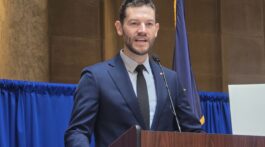


State Sen. JD Ford, the Democratic nominee for Indiana’s 5th Congressional District, is centering his fall campaign on affordability, health care, and a sharp contrast with Republican incumbent Victoria Spartz, arguing that everyday Hoosiers are being “squeezed” while Congress favors corporations and the wealthy.
In an interview this week, Ford said voters across the district — which includes urban, suburban, and rural areas — are most concerned about the rising cost of living.
He said affordability issues are “top of mind,” citing gas prices, utility costs, and grocery bills. Although the state has temporarily suspended the gas tax, he said residents are “still feeling the pain at the pump” and at the checkout line. Ford criticized what he described as inaction by the current officeholder on those issues, pointing instead to his own record in the Indiana Senate.
Ford noted his vote to end the 7% sales tax on utility bills and his support for House Bill 1002, which he called “a step in the right direction” toward providing cost relief for Hoosiers, though not a complete solution. He also pointed to a bipartisan, bicameral housing bill that he said could have been a national success story, but whose planned signing ceremony was canceled by the president. He warned about international investors buying up homes and driving up prices for local buyers, arguing that Congress needs to monitor and address the problem.
On the agricultural front, Ford said tariff policies associated with former President Donald Trump have left farmers “squeezed from both ends.” According to Ford, farmers struggle to sell their products because of “chaotic” tariffs, while imported farm equipment is also subject to tariffs, raising their costs. He said he wants to go to Congress to “fight on their behalf” and revisit those policies, which he said Spartz has supported.
Ford also stressed health care as a central campaign issue. He called the current system “completely broken” and argued for restoring and protecting Medicaid funding while opposing what he described as reckless budget cuts that threaten access to emergency and preventive care. He warned that a bill backed by Spartz — which he dubbed the “one big beautiful bill” — would remove roughly 650,000 Hoosiers from health coverage and place additional strain on rural hospitals.
In the state legislature, Ford said he helped cap the price of insulin and EpiPens and worked to reduce prescription drug costs in response to concerns from his constituents. He also pledged to protect reproductive freedom, saying health care decisions should remain between patients and their medical providers, not the government.
Addressing concerns about the national debt, Ford rejected criticism of Democratic spending priorities from Spartz and her allies. He argued that the tax and spending package she supported increased the deficit while delivering “fistfuls of cash” to what he called “the billionaire class,” even as programs that ordinary people rely on face cuts.
Ford, who emerged from a seven-way Democratic primary, said his campaign aims to unite different factions within the party while appealing to moderates and independents. He is specifically targeting so-called Lugar–Daniels Republicans who he believes feel politically homeless in the Trump-era GOP. Ford said he is “staying right in the middle,” promising practical, pragmatic decision-making based on what is best for the 5th District rather than for any party faction.
Ford reported raising more than $360,000 in the second quarter, a total he said reflects “momentum and strength” in the race. He highlighted small-dollar, grassroots donors giving $15 or $25 as evidence of enthusiasm for change. While lamenting the influence of money in politics, Ford said he intends to continue aggressive fundraising to compete with Spartz, who has the ability to self-fund, and vowed to “leave no stone unturned” in reaching voters across the district.