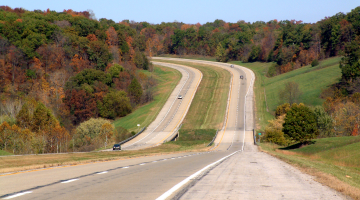










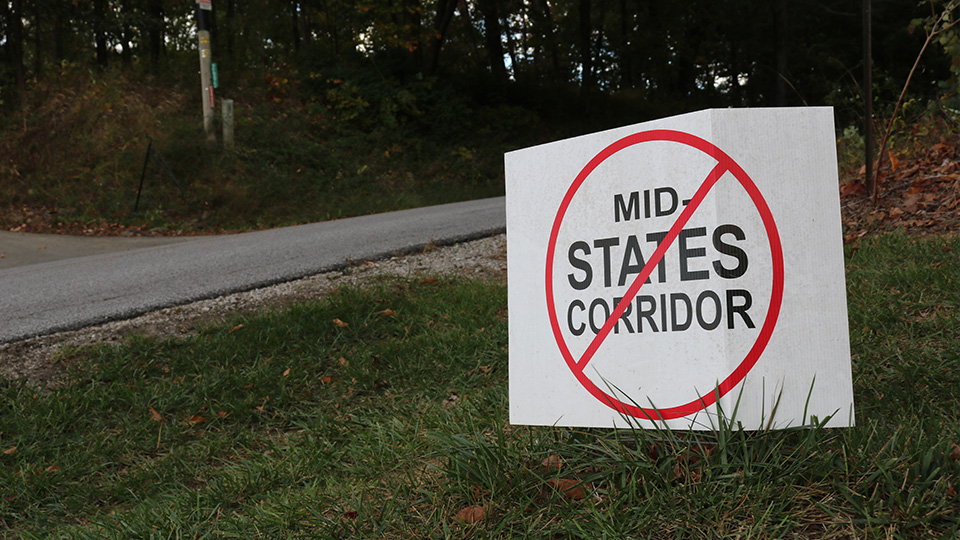
Questions about the controversial Mid-States Corridor took center stage at last week’s State Budget Committee hearing, as lawmakers pressed the Indiana Department of Transportation (INDOT) for answers about whether roughly 300 local road projects were shelved to help pay for the major highway initiative.
During the hearing, Sen. Fady Qaddoura told colleagues his office had received “disturbing” information from constituents in the region affected by the proposed corridor. He cited concerns about potential conflicts of interest involving bankers and companies that may profit from the project, as well as questions about whether certain elected officials or their businesses could benefit financially.
Qaddoura said he was “shocked” to learn that about 300 local projects may have been canceled without General Assembly oversight in order to move forward with the Mid-States Corridor. He urged the committee to investigate who made those decisions and who stands to gain.
“If there’s an economic development value for this, there shouldn’t be any lack of transparency,” Qaddoura said, arguing that lawmakers and the public deserve clear information on the project’s necessity, impact, and funding.
The budget committee’s scrutiny comes after months of mounting skepticism about the Mid-States Corridor. As Indy Politics has previously reported in “A Political Detour on the Road to the Mid-States Corridor,” a Public Policy Polling survey found overwhelming opposition in Dubois County, with voters warning of potential political consequences for supporters of the highway. Gov. Mike Braun, meanwhile, has publicly embraced additional scrutiny of the project, signaling he is comfortable with deeper questioning of its cost and impact.
At the same time, the Mid-States debate has been unfolding alongside Senate Bill 27, a measure widely marketed as a stadium bill aimed at luring the Chicago Bears to Hammond. As detailed in Indy Politics’ coverage, “45–4, a Stadium for Hammond — and Something Else Entirely,” that legislation also reshapes key funding and oversight mechanisms, prompting concerns among some lawmakers and local leaders that smaller road projects may be getting sacrificed to build a financial war chest for a handful of large, high-profile initiatives like the Mid-States Corridor.
Budget committee chair Sen. Ryan Mishler acknowledged the concerns at last week’s hearing and pointed to language passed this year that would require INDOT to bring very large road projects before the committee for review. Mishler said he believed the Mid-States Corridor is one of about six major projects that would be captured under that requirement.
“It’s my understanding that if it’s one of those six projects, it would have to come in front of this committee before they could move forward with it,” Mishler told members, adding that each project would be reviewed individually, not as a group.
Qaddoura formally requested that, before INDOT appears to present the Mid-States Corridor, lawmakers receive a full cost-benefit analysis, detailed project information, and a complete list of any local projects that were canceled or delayed to fund the corridor, along with the justification for each decision.
Other lawmakers pressed for clarity on whether the 300 projects were canceled outright or merely delayed. An INDOT representative at the meeting, who works on facilities rather than road construction, said he was not familiar enough with specific highway decisions to answer those questions.
Rep. Ed DeLaney supported the requirement that large projects appear before the budget committee, but warned that legislators had not fully accounted for the possibility that smaller, already-planned projects might be put on hold to build up a pool of money for a small number of high-dollar initiatives. He suggested lawmakers may need to consider additional statutory protections to keep INDOT from canceling local projects that are already underway or significantly advanced.
Mishler said he would ask INDOT to appear at a future budget committee meeting to present its road project pipeline, including the Mid-States Corridor, and to address questions about the fate of the hundreds of local projects lawmakers believe may have been affected.
“We will try to set that up,” Mishler said, noting that many members share the same questions about the Mid-States project and its broader impact on Indiana’s transportation priorities.