
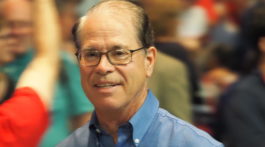




Gov. Mike Braun’s job approval stood at 35 percent in a statewide poll taken three weeks before Election Day, with 47 percent of likely voters disapproving, according to a post-election presentation from the Indiana Chamber of Commerce and its political arm, Indiana Business for Responsible Government (IBRG).
A year earlier, 34 percent approved of Braun’s job performance and 42 percent disapproved, according to the presentation. The same chart shows former Gov. Eric Holcomb’s approval peaking at 71 percent in 2019.
The survey also found voters turning negative on the direction of the state, President Donald Trump and the General Assembly.
Cygnal Research surveyed 600 likely voters Oct. 13-14. The poll has a margin of error of plus or minus 4 percentage points at the 95 percent confidence level.
Direction of the state
Fifty-one percent of respondents said Indiana is on the wrong track, compared with 38 percent who said it is headed in the right direction. The presentation describes that as a move from net +2 to net -13 in one year. A year earlier, 45 percent said right track and 43 percent said wrong track.
Trump and independents
Trump’s job approval among Indiana likely voters went from +6 to -8 over the past year, a net shift of 14 points, according to the presentation.
Among independents, 17 percent approve of the president’s job performance and 77 percent disapprove. The presentation says independents’ generic ballot preference moved 42 points from Republicans to Democrats in two years. It also says suburban white male Republican voters “broke strongly” toward Democrats.
The presentation identifies swing voters as 26 percent of the electorate and describes them as disaffected, right-leaning and very concerned about family finances. According to the survey, 62 percent of that group voted for Trump in 2024, and 56 percent now disapprove of his job performance.
The General Assembly
Twenty-four percent of respondents approve of the job the General Assembly is doing. The presentation compares that with 55 percent approval in 2019.
Issues
The cost of living was the top priority for state government, named by 43.5 percent of respondents. Taxes and government spending followed at 12.3 percent, then education (7.4 percent), crime and public safety (7.2 percent) and immigration and the border (7.1 percent).
The share of voters naming inflation and the cost of living as their top issue went from 29 percent in October 2025 to 44 percent in October 2026.
Asked about government’s role in the economy, 39 percent said government should play a limited role, 35 percent said it should take an active role and 21 percent said it should stay mostly out.
On economic development, 55 percent said it is often not worth it, strains resources and raises costs for residents. Thirty-seven percent said it is generally good and brings jobs, investment and tax revenue.
Fifty-nine percent supported increased state and local government funding for childcare and affordable housing. Twenty-eight percent were opposed, and 13 percent were neutral or gave another answer.
The election results
The presentation also reviews the Nov. 3 results. Republicans lost the secretary of state and comptroller races and the 5th Congressional District. The GOP’s House majority fell from 70-30 to 54-46, a net loss of 16 seats and the closest margin in 16 years, according to the presentation. Ten of the 16 seats that flipped are in Hamilton County and the Marion County suburbs, and the Speaker of the House was defeated.
In the Senate, the Republican majority fell from 40-10 to 35-15. Two winners of this year’s “redistricting” primaries lost in the general election, and the new president pro tem was nearly defeated, according to the presentation.
The 2027 General Assembly will have 39 first-year legislators, the most in any session on the presentation’s chart, which goes back to 2013. There will be at least 15 new committee chairs.
The presentation’s closing slides list possible primary fights, “chaos in the General Assembly” and new coalitions inside and outside the Statehouse as issues ahead. Its final slide asks whether Indiana again has a competitive two-party system.

