





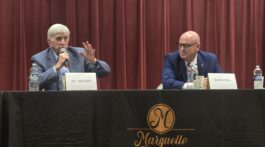





Republican state Senate candidate John Ruckelshaus is proposing the creation of a statewide “water czar” to centralize and oversee Indiana’s water policy, arguing that the current system is fragmented, opaque, and unresponsive to citizens’ concerns.
Speaking near Eagle Creek Reservoir in western Marion County, Ruckelshaus, who is running in Senate District 29, said worries over the reservoir and the LEAP District project have been a recurring theme as his campaign has knocked on nearly 8,000 doors in the district, which includes parts of Western Hamilton County, Carmel, Zionsville, Western Pike Township, Eagle Creek, and Wayne Township.
Ruckelshaus said at least five state agencies currently share responsibility for Eagle Creek and other water assets: the Department of Natural Resources (DNR), Indiana Department of Environmental Management (IDEM), Indiana Utility Regulatory Commission (IURC), Office of Utility Consumer Counselor (OUCC), and the Indiana Finance Authority (IFA). That structure, he argued, leaves residents and businesses unsure where to turn with questions or complaints.
“What we’re proposing is the consolidation of water management in the state of Indiana into the creation of an office called a water czar,” he said. He added that citizens and businesses should have “one throat to choke” and “one source of transparency” for all water-related decisions.
The proposed water czar would be a cabinet-level position appointed by the governor but, in a first for Indiana, would require confirmation by the Legislative Council, which is composed of Republicans and Democrats in equal numbers. Ruckelshaus said that step is intended to make the position “above politics” and to signal a commitment to transparency.
The office’s authority, he said, would extend beyond reservoirs such as Eagle Creek and Geist to include aquifers, underground waterways, and all water resources tied to economic development, including data centers and large industrial projects like the LEAP District. A key early task would be a comprehensive inventory of the state’s surface and subsurface water resources to guide future development decisions.
Ruckelshaus framed the proposal as streamlining government, not expanding it, by consolidating overlapping responsibilities. He acknowledged that details on how authority would be divided or removed from existing agencies would be worked out in the legislative process.
He also tied the initiative to his family history, noting that his uncle, William Ruckelshaus, was the first administrator of the U.S. Environmental Protection Agency and played a central role in the passage of the Clean Water Act of 1972.
Ruckelshaus said this would be the first bill he introduces if elected and that he is already speaking with former Senate colleagues to secure bipartisan sponsorship. He described District 29 as “the most competitive seat in the state…a total toss-up.”