

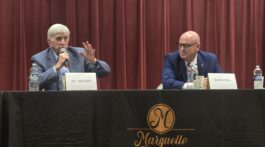







More than 100 people gathered at Marquette Senior Living on Indianapolis’ north side to hear Indiana House District 86 candidates Ed DeLaney, the Democratic incumbent, and Glenn Bill, the Republican challenger, discuss issues facing Indiana.
Data-center development emerged as a major point of disagreement. The candidates also addressed roads, wetlands, marijuana legalization, public schools, judicial residency, and election fairness.
Data centers: investment versus costs
DeLaney called data-center development one of the most complex issues facing Indiana. He raised concerns about water use, electricity demand, pollution from backup diesel generators, and the public costs of supporting these facilities. He also questioned tax breaks for data centers, saying the companies should pay the full costs of the resources and infrastructure they use.
Bill emphasized the potential investment and revenue data centers could bring to the state. He said concerns about their effects may be overstated, and argued that landowners should be able to sell their property. He said data centers should pay for what they use and that Indiana should not offer them incentives. Drawing on his real estate background, he said he could help negotiate better deals for residents.
The candidates also differed over how best to ensure companies cover those costs. Bill emphasized negotiation and his experience in real estate; DeLaney argued for legislation, careful planning, and competent state oversight.
Roads and property taxes
Both candidates raised concerns about roads and infrastructure. Bill pointed to potholes and a funding shortfall for Marion County roads, calling for a creative way to address the need. He also made property-tax relief a priority, arguing that homeowners are carrying too much of the burden.
DeLaney said he had helped secure an additional $50 million a year in state support for Indianapolis roads, and argued that road funding should be distributed more fairly. On property taxes, he said Indiana’s decision to cut the corporate tax contributed to greater reliance on property taxes.
Wetlands and development
Both candidates recognized the role wetlands play in the environment, including in flood control and water quality, but differed on how to balance their protection with development.
DeLaney supported protecting and restoring wetlands. He discussed mitigation—allowing some wetlands to be removed if developers contribute to replacing them elsewhere—and said the state could do more to create or expand wetland areas.
Bill said wetlands are important but argued that development should not always be stopped over small areas of wetland. He pointed to engineering and redevelopment as possible ways to address wetland impacts.
Marijuana legalization
Bill supports legalizing marijuana with strict regulations, including age limits. He cited potential relief for people with chronic illnesses such as cancer and multiple sclerosis, and argued that legalization could keep business and revenue from going to neighboring states.
DeLaney said he was open to medical marijuana but raised concerns about broader legalization while federal law still prohibits transporting marijuana across state lines. He said he would consider legalization if federal law changed and the state adopted careful regulation.
Other issues
On judicial residency, Bill said judges should live in the places where they serve. DeLaney supported allowing judges to live in an adjacent county, citing shortages of lawyers and difficulty recruiting judges in rural areas.
On religion in public schools, DeLaney emphasized separation of church and state and cited existing “release time” programs, as well as the possibility of comparative religion courses for older students. Bill opposed forcing religion on students but suggested exploring optional ways for interested families to access religious or spiritual instruction.
Both candidates criticized white Christian nationalism and said it had no place in political life. On gerrymandering, DeLaney called for reforms, including a voter referendum process. Bill also criticized gerrymandering but said political engagement and possible changes to the party system could help address public frustration.
The candidates also supported the proposed constitutional amendment allowing denial of bail to people considered likely to reoffend. They differed on the proposed change to residency rules for city and town court judges, with DeLaney citing rural judicial shortages as a reason for flexibility.
The forum offered voters a wide-ranging comparison: DeLaney stressed public investment, regulation, and legislative reform, while Bill emphasized private-sector experience, economic opportunity, and practical solutions.