





by Mackenzi Klemann, Indiana Capital Chronicle
October 13, 2026
A little-known statewide office responsible for disbursing and reporting how Indiana’s state tax dollars are spent is on the ballot this election season.
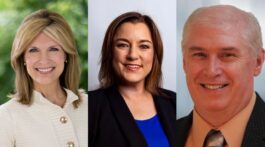
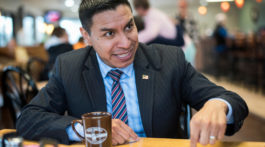
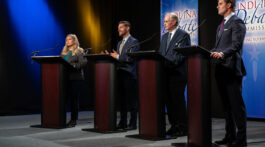
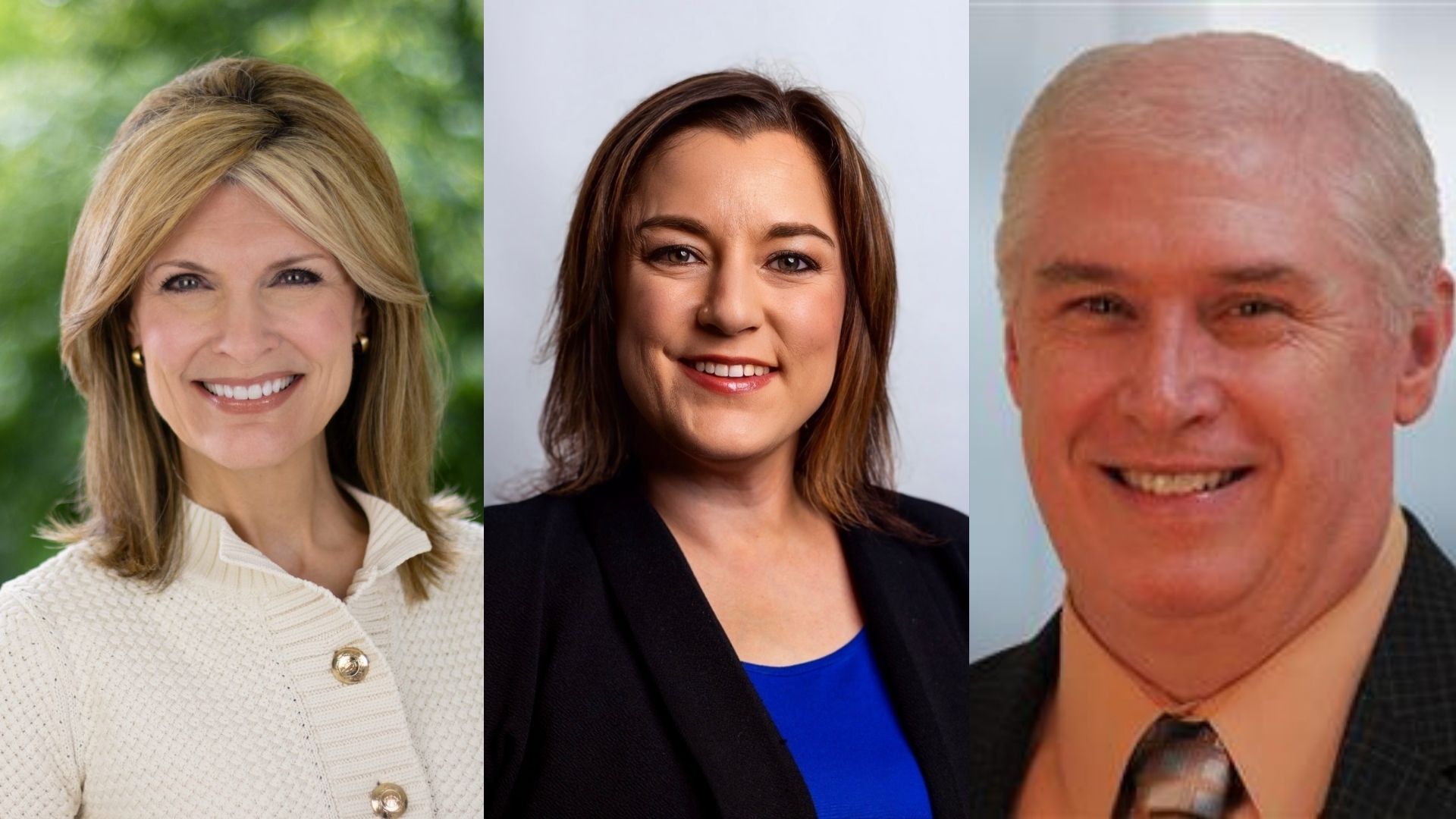
Three candidates are vying to be Indiana’s next comptroller: Incumbent Elise Nieshalla, a Republican, is seeking re-election against Democratic nominee Jessica Bailey and Libertarian John Schick.
The comptroller, formerly known as the state auditor, is responsible for accounting, disbursing and reporting how Indiana spends its $26 billion in annual state general fund revenues.
Former Gov. Eric Holcomb appointed Nieshalla to the position in 2023.
The comptroller compiles an annual financial report for lawmakers and governors to plan future budgets, pays the state’s 30,000 employees, disburses funds to state agencies and local governments and administers Indiana’s deferred compensation fund.
She also manages the state’s transparency portal, intended for Hoosiers to know how their tax dollars are spent, and is a member of the State Board of Finance.
Nieshalla describes her ascent to the position as a natural progression from president of the Boone County Council and Indiana County Councils Association.
She spent the previous two decades in economic development and real estate acquisition for the Indiana Department of Commerce, now known as the Indiana Economic Development Corporation.
The role taught her the basics of state government — “it’s all about jobs,” she said.
“For a long time, I’ve known that it’s my responsibility to do my part to keep the republic,” Nieshalla said, adding: “And here I find myself now as a leading financial officer for the state of Indiana, and doing my utmost to keep Indiana fiscally strong, disciplined, responsible and transparent.”
Democrat Bailey is finishing her second term as clerk of courts for Porter County, where she manages marriage licenses, traffic and criminal records and oversees county elections. She also spent six years with the Porter Township school board.
The apolitical nature of the comptroller’s office is attractive to Bailey, who said she was inspired to seek the nomination to make Indiana’s transparency portal more accessible to the average Hoosier.
As clerk of courts, Bailey said she started a mobile voting center out of a single-wide trailer for Porter County residents whose community polling centers had closed, so early voting wouldn’t be so inconvenient.
“I think if we just put some of that out-of-the-box thinking into the comptroller’s office, it’ll make it much easier and more accurate for Hoosiers to get information functions like the transparency portal,” she said.
Schick, a Northwest Indiana management consultant now in his fourth campaign for comptroller, joined the Libertarian Party in 2002. He rose through the ranks as secretary for the state central committee and now district leader for Congressional District 1.
Schick sees his political outsider status as an asset for the office, which he said would benefit under the direction of a comptroller who is not a member of either major political party.
“An independent state comptroller would make it clear that it’s run independently (of the governor and legislature),” he said, “and isn’t there just to have the same set of priorities as the legislature that’s making the decisions.”
Inside the transparency portal
Nieshalla is proud of Indiana’s transparency portal, an online database of state assets, contracts, employees, finances, local governments and vendors. “It’s a phenomenal tool,” she said.
In May, Nieshalla launched a new dashboard dedicated to federal expenditures in Indiana.
Federal funding surged from an average of between $12 billion and $14 billion a year to $26 billion at the peak of the coronavirus pandemic and has remained elevated since then, she said.
“When you have that much money coming into a state so quickly … those dollars are vulnerable to fraud, waste and abuse because of the administration and assimilating those funds in so quickly,” Nieshalla said. “So we needed to have the brightest sunlight on those dollars to be able to look back and look forward and say, ‘Are those dollars being spent as they were intended?’”
The federal number is now dropping each year.
National debt advocacy
Nieshalla and state Treasurer Daniel Elliott formed a coalition of 37 state financial officers who lobby lawmakers to take action on the $40 trillion national debt, leaning on Indiana’s balanced budget amendment as a model for the federal government.
Failure to act could result in national bankruptcy — eroding the U.S. dollar’s status as the world’s reserve currency, she said.
Nieshalla worked with Hoosier lawmakers as chair of the National Debt Crisis Task Force for the State Financial Officers Foundation on a resolution asking the federal government to act. Other states are doing the same.
“They’re working to get it passed in as many states as possible to build this movement from the states, because what we’re asking the federal government to do is some of the most difficult work,” Nieshalla said, as it will require reforms of America’s most popular social programs: Medicaid, Medicare and Social Security.
“We’ve got to get back to basics and understand that resources are finite and that there are consequences for a debt load of $40 trillion … and $1 trillion in annual cost of interest.”
Bailey and Schick each said the national debt is concerning, but they would prefer to focus their attention on state issues where they could have more impact.
Opponents push to improve portal
Bailey and Schick each said they’d like to make the portal more user-friendly to the average Hoosier.
“Republicans talk a lot about the state transparency portal, but it’s not very transparent,” Schick said. “When you get into it, you realize it’s not really giving you very much information about how much money is being spent.”
A search of state expenditures in his home Porter County shows “60% of all spending goes into a single account called settlements,” he said, “and it doesn’t describe at all how all that money is being spent.”
If elected, Schick said he’d “completely” rework the site and issue regular press releases about how state monies are spent on issues of the day like Flock cameras. “It’s spending of public money and should not be hidden behind a wall of opacity,” he said.
Bailey said there are practical solutions to site glitches — case sensitive searches requiring the exact spelling of an employee or contractor’s name, which she said could be corrected to function more akin to Google by generating suggested names and search terms.
She’d like to add other information too about the prevailing wage and minimum standards for state contractors.
“It’s a very good tool, and I think it’s a good starting point,” she said.
Bailey wants more focus on State Board of Finance
The three-member State Board of Finance supervises state funds — authorizing loans, appropriations and transfers made between accounts that don’t require legislative approval.
Bailey said she’d like to see the board engage in more public discussion, so Hoosiers aren’t left out. The meetings often last only a few minutes.
“As a county official, if I need more money in my budget, or if I need to transfer money within my (accounts), I go to the county council,” she said. “They are the fiscal stewards of the county money. … They want to know why it wasn’t high enough. They want to know where the money went, what the expenses were, what cost went up and what I plan to do with the additional money.”
The State Board of Finance should do the same, she said. “But there’s no discussion at a public meeting, so how are taxpayers across the state supposed to know what’s happening with their money?”
Nieshalla said board members review information in advance to “make sure it’s on the up and up.” Many requests are routine, she said. Others are subject to additional scrutiny: “We do our due diligence to make sure we understand the request, why, what it’s going toward and then we vote yea or nay.”