


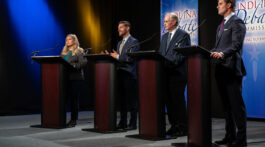








Four candidates for Indiana Secretary of State clashed over election integrity, voter access, business services, and political reform during a wide-ranging debate hosted by the Indy Chamber, Fox 59, CBS 4, and IBJ in Indianapolis.
On stage were Republican Max Engling, Democrat Beau Bayh, Libertarian Lori Shillings, and Lincoln Party candidate Greg Ballard, the former mayor of Indianapolis. Moderators Dan Spehler of Fox 59 and Leslie Weidenbener of IBJ stressed the race’s significance, calling it one of the most closely watched contests on Indiana’s November ballot.
Partisanship and Election Oversight
One of the opening lines of questioning focused on whether the candidates would keep the elections division nonpartisan and resist national political pressures.
Shillings said the office should be run “neutrally” and “ethically,” adding that she is “not beholden to anybody in party leadership.” Ballard echoed that elections are fundamentally a state responsibility and criticized the sharing of Indiana voter data with the federal government, saying that “should not happen.”
Bayh and Engling both pledged to avoid partisanship in administering elections. Bayh criticized the current secretary of state for sending private data on 5 million Hoosier voters to the U.S. Department of Justice “without even being asked,” while saying he supports appropriate cooperation with federal authorities. Engling argued the elections division is already structurally bipartisan and said he has been working with county clerks and the clerks’ association to ensure elections are run “in a nonpartisan fashion.”
All four candidates said they support maintaining a nonpartisan structure in the elections division.
Recount Controversy and Voter Confidence
The candidates were pressed repeatedly on a recent state senate primary recount in which a handful of ballots were thrown out after local officials mismarked them.
Engling defended the recount commission, saying it “followed the law” and suggesting that ignoring statutory requirements in order to count disputed ballots would be inappropriate. Shillings agreed the commission followed the law, but flagged “human error” and called for better tools and training for local election officials.
Bayh and Ballard took a different tack, both indicating they believed the disputed votes should count if voter intent was clear and there was no evidence of fraud. Bayh argued that discarding ballots due to government error undermines voter confidence, while Ballard called for the recount commission to be composed of five retired judges instead of partisan appointees.
Voter Turnout, Voter Guides, and Apathy
With Indiana’s voter turnout among the lowest in the nation, candidates were asked how they would boost participation.
Ballard promoted his proposed statewide voter guide, in both print and app form, as a key tool to inform voters about candidates, ballot questions, and procedures. He estimated the cost at about $2.5 million and contrasted that with what he called expensive, “very closed” primary elections funded by taxpayers. Ballard pointedly noted that the state spends roughly $10 million every election cycle on primaries, telling Engling and the audience that if parties paid for their own primaries, the state could instead use those dollars to help voters.
Bayh and Engling both opposed the guide on cost and effectiveness grounds. Bayh argued the primary problem is voter apathy driven by perceived self-dealing and corruption in state government, not a lack of information, and pledged an independent audit of the secretary of state’s office on his first day. Engling called the guide an unnecessary “2.5 million dollars for a piece of paper” and said the state should leverage digital tools, community partnerships, and youth engagement instead.
Shillings attributed low turnout largely to “bad options on the ballot” and distrust in elections fueled by national rhetoric. She called for greater transparency in post-election audits to show voters how results are verified.
Save Act, Voter Fraud, and Federal Role
The candidates split over the Republican-backed federal Safeguard American Voter Eligibility (SAVE) Act, which would tighten proof-of-citizenship requirements for federal elections.
Shillings and Ballard opposed the measure, calling it an unnecessary federal intrusion that would create barriers for women and others who have changed names or lack ready access to documents. Bayh said Indiana already has strong protections, including voter ID, and argued Congress should not dictate state election procedures.
Engling endorsed the proposal and said it would have minimal practical impact on Indiana while reinforcing the principle that only citizens should vote. He cited a report indicating 165 ineligible individuals were on the voter rolls and 21 voted illegally, arguing that “even one illegal vote is too many,” and suggesting opponents of stricter safeguards are unfit for the office.
Other candidates agreed that any illegal voting is unacceptable but questioned the scale of the problem and the cost of enforcement efforts.
Business Services and Website Modernization
The debate also highlighted the secretary of state’s business role. Ballard and Shillings sharply criticized the current business services website as outdated and difficult to use. Shillings, an entrepreneur, said she wants a modern, user-friendly portal that works for people who can only complete filings late at night and need fewer “404 errors” and less dependence on phone support.
Bayh said the business section of the website should focus less on self-promotion and more on connecting users to tools such as the Small Business Development Center, as well as providing basic financial literacy resources. Engling defended Indiana’s overall business climate and said his own experience registering a business was “pretty straightforward,” but acknowledged there is room for improvement, particularly by reusing data already submitted to the state instead of forcing repetitive filings.
All four candidates said they support greater transparency around business ownership and using available data to track fraud, including shell companies that dissolve and re-form to evade accountability.
Reform, Third Parties, and Future Ambitions
In closing segments, candidates were asked about political competition and their own future plans.
All four pledged to serve a full term if elected. Ballard and Shillings, representing minor parties, sharply criticized Indiana’s ballot access and primary rules as protecting the two major parties and limiting voter choice. Bayh compared one-party dominance in state government to an economic monopoly that weakens accountability, while Engling said competition is healthy but stressed that parties and candidates must clearly define and live up to their platforms.
The candidates closed by appealing directly to voters: Bayh emphasized unity and public service, Ballard urged Hoosiers to use this election to “change the government in Indiana,” Shillings called on voters “tired of what we’ve been doing” to “vote differently,” and Engling asked for support to “build on the good things” Indiana is already doing and to strengthen election integrity and business services for the next generation.