












by Andrew Dezelan
The legislature wrote the test for township mergers. Nobody wrote the study guide.
Indiana spent twenty years arguing about whether townships should exist. That argument is over. Senate Bill 270 is law, and by December 31 the Department of Local Government Finance will publish a scorecard grading every township outside Marion County on ten criteria. Rack up four points and you’re a “designated township” — a polite way of saying you’re merging with a neighbor or reorganizing into the city that surrounds you.
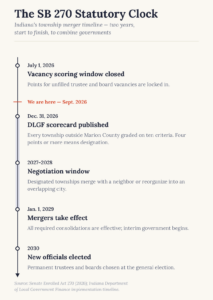
The clock is already running. The first scoring window quietly closed July 1: townships that filled trustee and board vacancies before then erased those points; everyone else is stuck with them. The scorecard drops December 31, leaving 2027 and 2028 to negotiate and execute a merger — effective January 1, 2029, with new officials not elected until 2030. Two years, start to finish, to combine governments.
How many? Indiana has roughly 1,000 townships — 997 or 1,014, depending on which report you’re reading. The bill’s own author, Sen. Rick Niemeyer, put about 325 of them in its crosshairs during Senate debate. Discount that number however you like and call it 200. That’s still 200 forced consolidations on a statutory clock. And here’s what I can’t stop thinking about: nobody talked about the benefit contracts.
That’s not supposed to be possible. The legislative process is redundant by design. A bill gets an author, then LSA drafting and fiscal analysis, then trade associations and advocacy groups combing every line, township lobbyists, caucus staff in both chambers, the governor’s office before signature. A dozen sets of professional eyes, precisely so the big stuff can’t slip through. Sen. Jean Leising even warned on the floor that the state was moving too fast, with too many unanswered questions. She was more right than she knew. In all the testimony, debate, and coverage, I never saw anyone raise the benefits question. If somebody did, I’d genuinely like to see the transcript. Everyone was silent on this — including Sen. Greg Taylor. You’re telling me Greg Taylor didn’t speak on a bill? Lies. And yet, it’s true. This flew past everyone.
Committee is where this stuff normally gets flushed out. But the Local Government Committee meets Thursday mornings at 10, so let’s be honest: nobody was paying attention. I spent a decade in that building. I know.
Here’s why the silence is a problem. A township isn’t just a line on a map. It’s an employer. Its employees have health insurance, life insurance, dental, retirement contributions, and payroll — each governed by carrier contracts with its own renewal date, rate structure, and plan design. Some townships run fire departments, which means firefighter benefits, which is its own category of complicated.
Now staple two of those employers together inside that two-year window. Township A renews with one carrier in January. Township B renews with another in July — different deductible, different network, and a retiree from 2011 still on a plan design no carrier would write today. Which plan survives? Who tells the employees whose out-of-pocket costs just changed? Who’s even authorized to sign the new contract mid-reorganization? Merge a designated township into a city and it gets harder: municipal plans, different eligibility rules, sometimes collective bargaining.
None of this is unsolvable. Employers combine benefit programs all the time — with HR departments and consultants who’ve run the playbook before. Under SB 270, it lands on part-time trustees and three-member boards who have never executed an integration in their lives.
The legislature wrote the test. Nobody wrote the study guide.
So here’s my unsolicited advice to every trustee who suspects a four-point score, and every board next door that might inherit one: don’t wait for December 31. Inventory every contract — health, life, dental, vision, payroll, fire protection. Write down the renewal dates. Ask your carrier, in writing, what happens to your plan in a merger. Then have the same conversation with your likely merger partner, because the worst time to discover a benefits problem is after the reorganization plan is filed.
The scorecard isn’t the finish line. It’s the starting gun. Townships that treat the next two years as an integration project will come out fine. The ones that treat it as a press release will spend 2029 explaining to their employees why the deductible tripled.
Somebody should have said this in committee. Consider it said now.
Andrew Dezelan is a benefits advisor to Indiana municipalities and small businesses, a former Indiana Senate Democratic Caucus policy director, and host of The Open Seat podcast.