








by Abdul-Hakim Shabazz, Esq.
UPDATE (July 27, 2026): After this piece was published, Sen. Spencer Deery’s camp contacted IndyPolitics to say that they dispute the characterization of the Tippecanoe County absentee ballot described above. The sentence “Deery’s lawyers don’t deny that’s what happened” referred to the filings before the Recount Commission as of publication, all of which are procedural — a motion to dismiss, subpoena objections, a protective-order request, and the Parke County motion. None of them addresses the ballot on the merits, and to be fair to Deery, none of them had occasion to. We have asked his side to identify which specifics they contend are wrong — how the ballot was stored, who opened it, and whether it was processed without a board, absentee counters, or a signature check — and we will report their answer when we get it.
IndyPolitics obtained Paula Copenhaver’s latest pleadings Friday night — filed at 11:30 p.m. Fifty-seven pages of reply brief, a motion to strike, and her list of which ballot disputes she’s keeping. We’ve rewritten Sunday’s column to account for them.
Three votes. That’s the certified margin in Senate District 23 — Republican Sen. Spencer Deery at 6,337, challenger Paula Copenhaver at 6,334, about two one-hundredths of one percent.
Or two votes. Or one. Her own filing Friday night asks the Recount Commission to throw that number out and use the tally as it stood at noon on May 18, which was 6,336 to 6,334, and a footnote in her brief concedes the real margin may be a single vote once two disputed ballots get ruled on. Hang onto that. It means the eleven voters her lawyers want to depose may not be the ballgame at all. They may be the insurance policy.
Because that’s still the ask. Subpoena eleven Hoosier voters, put them under oath, and ask them who they voted for.
Seriously.
It was fourteen a few weeks ago. Three of those names got dropped after her lawyers worked out that the voters don’t live in Senate District 23. Remember that when you get to the part of Friday’s brief that spends a full page insisting these voters were carefully validated and are absolutely not, as Deery’s side put it, random or unknown. Fourteen names. Three of them wrong about what district the person lives in. That’s the easy question, and they missed it one time in five. Now they’d like to be trusted on the hard one.
We think the Commission should say no Tuesday morning, and after reading all fifty-seven pages we still don’t think it’s close.
Start with the fact that Indiana does not register voters by party and never has. What we have instead is a statute, IC 3-10-1-6, saying you may vote in a party’s primary if you backed a majority of that party’s nominees last November, or, if you sat that one out, you intend to affiliate with the party next time.
Read it again. One half asks what you did inside a voting booth two years ago, which the secret ballot makes it impossible for anyone on earth to check. The other half asks what you intend to do inside a voting booth three months from now, which nobody can disprove. One is unverifiable. The other is unfalsifiable. And Copenhaver proposes to establish one of them by a preponderance of the evidence, eleven separate times, against witnesses who by then will have lawyers. Deery’s attorney, Samantha DeWester, puts it more plainly and she is right: there is nothing illegal about changing your mind about a political party.
Second, the remedy she wants existed on May 5, and she didn’t use it. The law lets a voter challenge someone who “offers to vote” at a primary — present tense, at the polls, before the ballot is ever marked. The challenger has to belong to the same party whose ballot is being pulled, which Copenhaver does. The challenged voter then signs a party-affiliation affidavit under penalty of perjury and — read the state’s own PRE-6 form — casts a regular party ballot, expressly not a provisional one.
That’s the whole case right there. Challenge a Hoosier over photo ID or registration and he gets a provisional ballot: segregated, sequestered, reviewed after Election Day on a fixed schedule. The General Assembly knows exactly how to build a post-election review track. It has built several. It declined to build one for crossover voting, because the affidavit at the polls is the remedy and it works on the spot.
Nothing in Friday’s fifty-seven pages answers that. Her lawyers argue the poll challenge isn’t the only remedy. They never explain why the legislature handed the challenged crossover voter a regular ballot instead of one somebody could pull back out later.
Third, the grounds for contesting a nomination are a closed list: an ineligible winner, a mistake printing or distributing ballots, a programming error, a machine malfunction, or a deliberate act making it impossible to tell who got the most votes. “Eleven Democrats pulled our ballot” isn’t on it.
Her answer is Pabey v. Pastrick, which she cites six times for the idea that the Commission has inherent power to fashion a remedy. Pabey ordered a special election. And her brief now concedes in writing that the remedy she actually wants — a certificate handing her the nomination — isn’t spelled out in the contest statutes at all. She asks the Commission to plug the hole with a catch-all clause letting it exercise any other necessary power.
So the ask, stated honestly, is that three people invent a remedy the General Assembly never wrote in order to award her a nomination she didn’t win.
Fourth, and this ought to end it: even if all eleven confess, nobody can find their ballots. Not lost. Commingled, on purpose, by design, so that no poll worker, no county clerk and no recount commission can walk backward from a voter to a piece of paper.
Her answer is IC 3-12-11-17.7, which lets the Commission figure out the approximate number of votes each candidate got in a precinct where there’s been fraud, tampering or misconduct. She reads that as permission to subtract particular votes she says were illegal. But that statute is written for precincts where the count has fallen apart. Stretching it to cover eleven named citizens means the Commission would be removing votes based on testimony about marks nobody can locate.
That’s not a recount. That’s an interrogation with an arithmetic component.
There’s also a Fifth Amendment fork here, and it cuts against her whichever way she turns. Sam Cody of Warren County told Based in Lafayette he’d exercise his rights if hauled in. Her brief saw that coming and asks the Commission to keep open the option of holding a voter’s silence against him. The case she cites for it, Baxter v. Palmigiano, says the Fifth Amendment doesn’t bar adverse inferences against parties to a civil action. These eleven aren’t parties. They’re private citizens who made the mistake of posting on Facebook.
And notice the trap in her own filing. She calls these votes illegal. If they’re illegal, it’s a criminal matter, the Fifth is squarely in play, eleven people invoke it, and the Commission learns nothing. If they’re not illegal, there’s nothing to depose anybody about. Pick one.
Now, in fairness, not everything in Friday’s filing is frivolous.
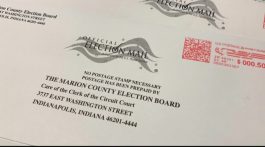
Copenhaver also raises a Tippecanoe County absentee ballot that turned up in an unsecured bag in a corner of the courthouse the morning after the election, and that the county clerk then personally opened and counted — no election board, no absentee counters, no signature check — knowing the race was inside three votes. Deery’s lawyers don’t deny that’s what happened. She raises Parke County re-certifying its results two days after the Commission impounded everything, because the provisional numbers hadn’t saved.
She’s entitled to ask about both, and so is the public. That’s the difference between examining what the government did with a ballot and examining what a citizen did in a booth. She has every right to the first. Nobody has a right to the second.
Which is the tell. If the ballot arguments got her there, she wouldn’t need the voters.
None of this is happening in a vacuum. Copenhaver is the Fountain County Republican chair, government affairs director in Lt. Gov. Micah Beckwith’s office, and a former Fountain County clerk. She carried President Trump’s endorsement because Deery wouldn’t fall in line on last year’s congressional redistricting push. This is that purge continuing by other means. If you can’t beat a sitting senator at the polls, beat him at the deposition table.
If Republicans want closed primaries, have that fight in the open. File the bill, register voters by party, take the heat in an election year. Common Cause’s Julia Vaughn, who’s been watching Indiana election law for three decades and has already called this subpoena request dangerous, will show up to oppose you, and it will be a real debate. That’s how a self-governing state settles this. What you don’t get to do is play by open-primary rules in May and closed-primary rules in July.
Meanwhile, the clock. Copenhaver wants the recount and the election contest tried together August 18. The deadline to certify candidates for the November ballot is August 21. Three days. Independent Joshua Brant already has ballot access, and Democrat David Sanders is up in West Lafayette watching Republicans depose their own voters in a district the GOP usually wins in its sleep. Keep this up and a safe seat becomes an interesting one.
The Commission — Secretary of State Diego Morales, Republican Paul Mullin and Democrat Michael Claytor — convenes at 9 a.m. Tuesday at Indiana Government Center South, and it’ll be livestreamed on the Secretary of State’s YouTube channel. Watch it. A two-to-one Republican panel is about to decide whether Republican primary voters can be made to testify about their ballots.
Three votes is a brutal way to lose an election. It is not a license to make Hoosiers explain themselves, under oath, for the sin of voting.
Abdul-Hakim Shabazz is the editor and publisher of IndyPolitics.org and an attorney licensed in Indiana and Illinois. He has also lost an election, and it never once occurred to him to subpoena the people who voted against him.