








The 2027 city-county budget introduced Monday night appears to book the $50 million in state road funding that Indianapolis has not yet demonstrated it qualifies to receive — five days after council Democratic leadership said the city has not identified the revenue needed to claim it.
The money never appears under that name. It shows up as a $54.8 million increase in intergovernmental revenue in the Transportation General fund, which Proposal 264 projects at $147,250,294 for 2027, up from $92,498,990 in 2026.
In the same fund, interfund transfers out grow from a negative $41.7 million to a negative $92.4 million — roughly $50.7 million more flowing out than in 2026. The Capital Asset Lifecycle and Development fund, which receives transfers, shows revenue climbing from $46.7 million to $116.3 million, and the Department of Public Works capital line within it rising from $40.4 million to $102.5 million.
The ordinance nowhere identifies a state road match, and does not cite IC 8-23-30-2, the statute that governs the distribution.
Under that statute as amended by PL 147-2026, Indianapolis can receive $50 million annually beginning in 2027 only if it provides a local match from a new revenue source. Other state road distributions and public safety local income tax revenue are expressly excluded. The city self-certifies its compliance to the state comptroller by Dec. 31, and a unit that misses the match in any year becomes ineligible in every year after.
Mayor Joe Hogsett vetoed the council’s vehicle excise surtax and wheel tax increase on July 16. In a recorded veto message, he said the increase asked too much of residents already stretched thin, that his administration could meet the state’s funding requirements without it, and that the plan had already been shared with the council.
The wheel tax was never a condition of the $50 million. That requirement sits in a separate part of the statute governing a different distribution. Marion County already levies both taxes; the proposal would have raised them. What the statute requires is that the match be new revenue — it does not say how the city must raise it.
The budget introduced Monday shows what growth is available to do that, and where it is restricted.
Local income tax revenue is up across the board. The Consolidated County Fund’s income tax line grows from $254,129,853 to $279,008,517, an increase of $24.9 million. Public safety income tax rises from a combined $166 million to $179.9 million, up 8.3 percent. The public safety communications allocation grows $2 million, to $25 million. County General’s income tax line does not move at all, holding at $36,087,978 both years.
Most of that growth cannot be used for roads. Public safety income tax may be spent only on public safety under IC 6-3.6-6-8, and is separately excluded from the match by the road funding statute. The communications allocation is dedicated to the emergency services agency.
That leaves roughly $25 million in unrestricted income tax growth — about half the match.
Other candidates are thin. Stormwater charges for services grow from $50.4 million to $52.3 million, but net miscellaneous revenue in that fund is slightly lower in 2027 than 2026. The existing wheel tax, unchanged after the veto, grows from $15.7 million to $16.6 million.
The statute does not say who decides whether ordinary revenue growth counts as a new revenue source, or whether growth in an existing tax qualifies as new at all. The city certifies to the comptroller itself.
The requirement also escalates: $70 million in 2028, $80 million in 2029, $90 million in 2030 and $100 million in 2031 and after, with part of each increase required to be revenue the city has not already counted. A match built on one year’s income tax growth would have to be rebuilt, larger, every year.
On Aug. 5, a statement issued by Denise Herd for council Democratic leadership said the caucus lacks the 17 votes to override the veto, that the city has not fully identified resources for the match, and that the gap would appear as service and staffing reductions in the 2027 budget.
Those reductions are not obvious in the ordinance. Total appropriations across city and county government come to roughly $1.9 billion by a tally of the department and sinking fund totals. IMPD’s general fund is appropriated $333.2 million and the fire department’s $250.5 million.
What is visible are higher property tax rates. All three special service districts go up: police from $0.0922 to $0.1052 per $100 of assessed value, fire from $0.2442 to $0.2837, solid waste from $0.0722 to $0.0825 — increases of 14, 16 and 14 percent.
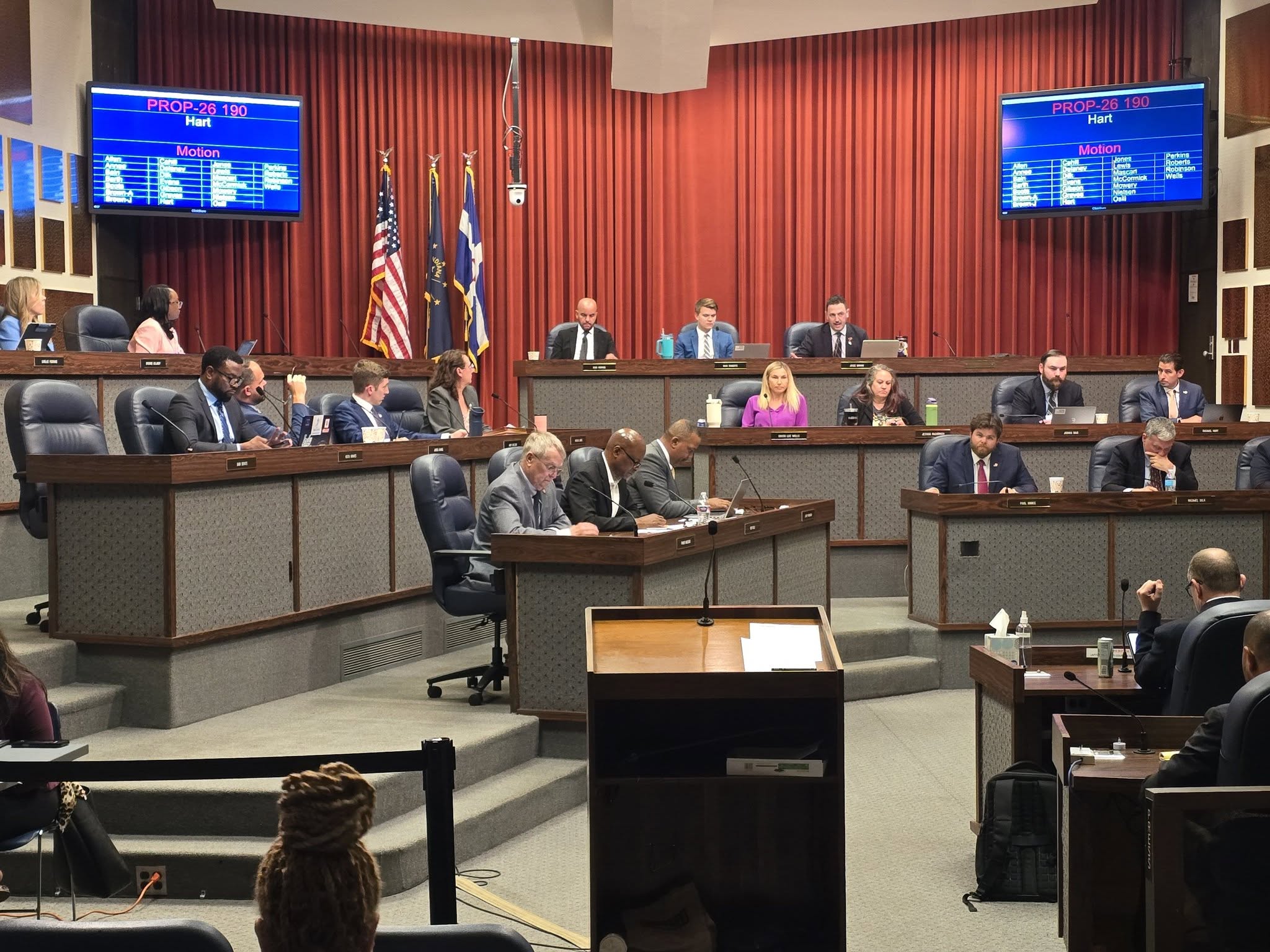
Proposal 192 returns Monday under unfinished business. The budget is referred to five committees and will not be adopted until October.
The road money is not the only fight on the agenda. Under final adoption, the council takes up Proposal 238, the zoning amendment governing data center development, which cleared the Metropolitan and Economic Development Committee 10-3 as amended on July 13.
Councilor Jesse Brown told colleagues in an Aug. 6 email that he will move at Monday’s meeting to remove three council-appointed members of the Metropolitan Development Commission — Brandon Herget, Daniel Moriarty and Gregg West — under IC 36-7-4-218(g), citing their votes on data center petitions and their refusal to advance a moratorium. No such item appears on the draft agenda, meaning Brown would have to raise it during adoption of the agenda or under new business.
The dispute behind both items is procedural: whether the commission could have imposed a moratorium on its own, or whether certification of proposal 2026-AO-001 moved the decision to the council. Brown put that question to the commission in a July 14 open letter; Department of Metropolitan Development Director Megan Vukusich responded the following day that the council holds the ball.