


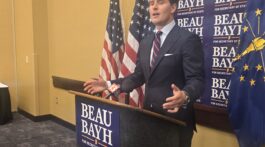
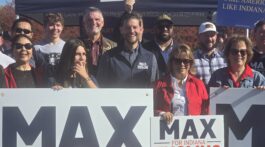


At a final campaign event held in a union labor hall, a Democratic candidate for Indiana secretary of state called for stronger support for organized labor, expanded voting access and citizen-led ballot initiatives, while criticizing the current administration’s spending and contracting practices.
The candidate said the hall was a fitting place to close the campaign, describing support for collective bargaining, fair wages, benefits and safe working conditions as central to his political beliefs. He thanked labor supporters and said he would work on their behalf if elected.
During the speech, the candidate cited concerns he said he heard while visiting all 92 Indiana counties, including rising costs, rural health care, public education and the state budget surplus. He argued that surplus funds should be used to make child care and health care more affordable, improve roads and bridges, and support public schools. He also criticized Indiana’s universal school voucher program, saying it directs public support to private education at the expense of public schools.
The candidate accused the current secretary of state’s office of corruption and insider dealing. He cited a luxury SUV purchase, family members’ appointments to state positions, overseas travel and no-bid contracts awarded to campaign donors. He pledged to order an independent audit if elected. These allegations were presented in the speech; the transcript does not include a response from the current officeholder.
He also criticized Max Engling, described in the speech as the replacement candidate, for supporting decisions made by current Secretary of State Diego Morales. The candidate said Engling’s priority was keeping the office in Republican hands, while he would focus on public service. He further alleged that state and national political figures had spent money attacking him and his family.
On election policy, the candidate called for protecting early voting, expanding Election Day hours and increasing voter participation. He said Indiana’s 6 a.m. to 6 p.m. voting window can make it difficult for working people to vote. He also advocated ending straight-ticket voting, arguing that voters should consider individual candidates rather than select a party slate.
The candidate proposed a bipartisan or nonpartisan redistricting commission and citizen-led ballot initiatives. He pointed to Missouri’s repeal of its right-to-work law through an initiative process as an example, and said Hoosiers should have a similar opportunity to decide major policy questions.
Beyond policy, he urged supporters to reject divisive politics and seek common ground across differences. Drawing on his experience as a Marine Corps infantry officer, he said people with different backgrounds can work together toward shared goals.
The event’s opening speaker also endorsed ballot initiatives and highlighted collective bargaining rights, saying state employees had last held those rights in 1990. The candidate closed by thanking supporters for their backing over the previous 14 months and promising to challenge what he called a “corrupt political machine.”

