









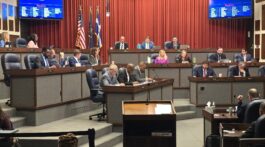

Indiana Supreme Court Hears High-Stakes Recount Fight in SD23 GOP Primary
The Indiana Supreme Court on Thursday heard fast-tracked arguments in a razor-thin Republican primary dispute that could decide the winner of the Senate District 23 race and clarify how far the state’s Recount Commission may go in rejecting ballots over technical defects.
The case, Senator Spencer Deery v. Paula Copenhaver, et al., centers on six absentee ballots from the May 5, 2026 primary that were thrown out because they lacked the county clerk’s seal and signature. After the initial count, incumbent Sen. Spencer Deery led challenger Paula Copenhaver by just three votes out of nearly 13,000 cast. A recount left the race hinging on those six disputed ballots.
The appeal came to the high court on a transfer petition under an expedited schedule. Each side received 20 minutes for oral argument.
Deery’s Side: Savings Clause and Voter Enfranchisement
Arguing on behalf of Deery, Indianapolis attorney Karen Celestino Horseman told the justices the Indiana Recount Commission misapplied the state’s “savings clause” — a statute that allows ballots that might otherwise be invalid solely because of an election official’s mistake to “nevertheless be counted” in a recount, so long as the voter complied with Title 3 and there is no evidence of fraud, tampering, or misconduct.
Horseman delivered the main argument for Deery and was joined at counsel table by attorneys Samantha DeWester and William Groth.
Horseman said the key word “may” in the statute does not grant the commission unfettered discretion to reject ballots simply for lacking a seal and signature. Instead, she argued, the commission must exercise judgment within defined limits: determine whether the ballot was lawfully cast, whether the only problem was an official’s act or omission, and whether there is any sign of fraud or tampering. If those conditions are satisfied, she contended, the ballot should be counted.
She argued the burden fell on Copenhaver, who opposed counting the six ballots, to show why the savings clause did not apply. Horseman noted there was no evidence of fraud or voter error, that all six ballots carried the required bipartisan initials, and that the missing seal and signature most likely reflected clerical oversight, such as a missed rubber stamp.
Broad, standardless discretion, she warned, would allow the commission to switch between strict and lenient approaches from one recount to the next, raising concerns about uniformity, non-discrimination, and potential partisan manipulation. Indiana’s long-standing election jurisprudence, she said, favors enfranchising voters and counting ballots where possible rather than disenfranchising them for officials’ mistakes.
Commission, Copenhaver: Authenticity and Mootness
Attorney William Bock argued for Copenhaver, while Benjamin Jones argued for the Indiana Recount Commission. They defended the decision not to count the six ballots and raised a threshold question of whether the case is now moot because statutory certification deadlines passed on August 21 and September 4.
Bock suggested the court could either dismiss the case as no longer justiciable or affirm the certification on the merits.
On substance, Bock and Jones emphasized the General Assembly’s long-standing concern over absentee ballot manipulation and fraud. They pointed to more than a century of statutes and case law requiring a clerk’s seal and signature as authenticity markers, especially in absentee voting where the voter is not physically present at a polling place.
Jones argued that bipartisan initials serve a different statutory function — ensuring both parties handled the ballot — and are not, by themselves, proof of authenticity. Without the clerk’s seal and signature, he said, the commission cannot simply presume the ballot is valid. He maintained that it is not an abuse of discretion for the commission to demand strict compliance with clear statutory text and prior Supreme Court precedent.
Pressed by justices about how six scattered ballots could realistically be fraudulent in this race, counsel responded that absentee voting carries inherent risks at multiple stages, and the legislature deliberately imposed strict safeguards.
Justices Probe Discretion and Voter Intent
The justices questioned both sides on the meaning of “may,” the scope of the commission’s discretion, and how to balance election integrity with voter rights.
Several justices focused on what standards prevent identically situated ballots from being treated differently. Others pointed to statutes elevating voter intent as the primary consideration when the ballot otherwise complies, suggesting the default should be to count votes absent a clear statutory bar.
In rebuttal, Horseman argued that affidavits from county clerks submitted during the recount already established the authenticity of the ballots and noted newer safeguards — including security paper requirements for absentee ballots — as additional protection against tampering.
Chief Justice Loretta Rush praised counsel on both sides for “excellent arguments” under tight deadlines and said the court would confer quickly and issue a decision as soon as possible.