


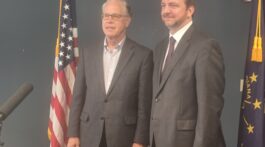

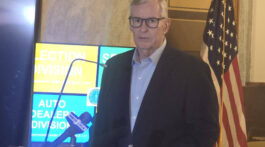
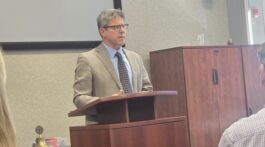





Former State Senator Jim Merritt says if Indiana is serious about growing its manufacturing base, welcoming power-hungry data centers, and cutting carbon emissions, it needs to get serious about nuclear power — specifically small modular reactors.
In a recent conversation, Merritt, a Republican who chaired the Senate Utility Committee from 2004 to 2020, argued that public perception of nuclear energy is still stuck in the era of Three Mile Island, Chernobyl, and Hollywood thrillers. The technology Indiana is now considering, he said, is something very different.
“This is not your father’s or your grandfather’s nuclear reactor,” Merritt said, pointing to small modular reactors (SMRs) and microreactors that he believes are poised to reshape how Indiana generates electricity.
Nuclear Already in the Mix
While debates over coal, natural gas, and renewables dominate Indiana’s energy politics, Merritt noted that nuclear power is already a quiet workhorse in the state’s portfolio.
Much of northeast Indiana gets its electricity from the Cook Nuclear Plant on Lake Michigan in Michigan, which supplies Indiana Michigan Power. Merritt said nuclear accounts for about 20 percent of Indiana’s power, mirroring its share of the national mix.
Despite that, he argued, most Hoosiers barely notice.
“There hasn’t been a spill. There hasn’t been any type of problem at Cook or the many reactors around the country,” Merritt said, adding that the plant has operated for decades without the kind of incidents that fuel public fear.
Smaller, Safer, and Easier to Site
Merritt’s pitch centers on the next generation of nuclear technology. Small modular reactors, he said, do not require the massive structures, large exclusion zones, or constant access to huge bodies of water that defined the first wave of nuclear plants.
According to Merritt, a typical SMR facility might need 25 to 35 acres of land and many designs can be at least partially buried, making them less visible and potentially less controversial. He said reactors can be paired directly with industrial users, large manufacturing operations, or major developments such as the LEAP District in Lebanon.
He also pointed to the Crane Naval Base in southern Indiana — roughly 66,000 acres of federal land — as a potential demonstration site. With a small modular reactor on a large, controlled footprint like Crane, he said, the state could create a model to show Hoosiers what a modern nuclear facility actually looks like.
From Coal Cars to Localized Nuclear
Merritt acknowledged that coal still plays a major role in Indiana, and that the state has “hundreds of years” of reserves. He noted that coal plants burn cleaner than in the past, but said both coal and nuclear continue to suffer from negative public reputations.
The difference, he argued, is that nuclear offers carbon-free baseload power without the transportation, emissions, and long-term image problems that come with coal.
He sees SMRs as a way to attach generation directly to demand — a blast furnace, a large factory, or a major industrial park — and eliminate some of the transmission and logistics issues that come with coal-fired plants.
“It’s just the new power source of this century,” Merritt said.
Data Centers and “Bringing Their Own Power”
Merritt also linked nuclear’s future to the rapid growth of data centers and AI-driven computing, both of which require large, constant sources of electricity.
He predicted that the “next generation of data centers” will increasingly bring their own power, pairing facilities with on-site SMRs rather than relying solely on existing grids. Some newer data center designs, he noted, are being developed to reduce or even eliminate the need for large quantities of cooling water — making them an even better fit with small modular reactors.
That approach, he said, aligns with what national and state-level Republican leaders want: new investment that builds reliable, clean generation without placing all the burden on traditional ratepayers.
Fear, Permits, and the Path Forward
Merritt was candid about the two biggest challenges: public fear and permitting.
On the public side, he said nuclear still brings to mind images of radiation clouds, movie scenes from Silkwood, and people “turning into the Incredible Hulk.” Changing that narrative, he argued, will require repetition and transparency — showing people that plants like Cook have operated safely and that modern SMR designs are even more conservative.
On the regulatory side, Merritt described permitting as “the elephant in the room.” Historically, he said, federal and local permitting has stretched nuclear project timelines to 10 or 11 years, driving costs and scaring off investors. He cited recent legislation at the Statehouse and moves at the federal level as attempts to shorten that timeline to around six years by cutting unnecessary delays while maintaining safety.
To push both arguments, Merritt has launched the Indiana Nuclear Power Association, which he said will focus on advocacy, education, and communication, rather than new laws. The legislature, he argued, has already laid a basic path for nuclear development; now the job is convincing Hoosiers that “not your grandfather’s nuclear” can be a safe, reliable, and largely unseen backbone of Indiana’s energy future.