

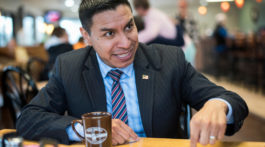





State Rep. Danny Lopez, a Republican from Indiana House District 39, told members of the Greater Lawrence Chamber of Commerce that Indiana’s long‑term economic health will depend on smarter tax policy, honest advocacy, and deeper engagement between schools and employers.
Lopez spoke at the Chamber’s “Chew on This” luncheon series, hosted by Matt Miles, chair of the Greater Lawrence Chamber, at an event that also recognized Keystone Group as title sponsor. Chamber president Brad Kloffenstein was noted as being out of state visiting family.
Lopez outlined his background in both the public and private sectors. Before his election in 2024, he spent five to six years as executive vice president of Pacer Sports & Entertainment, overseeing external relations, government affairs, media and communications, and community and philanthropic initiatives for the Pacers organization and related entities, including Gainbridge Fieldhouse operations. He now leads Ven Cam Public Relations and continues to advise Herb Simon’s development company on downtown Indianapolis projects, including the Fieldhouse District.
At the Statehouse, Lopez serves on the powerful Ways and Means Committee, working on taxation, budget, and school funding, and on the Judiciary Committee, which he said has recently focused on family law and immigration. He represents the east side of Carmel and part of Westfield, describing it as a highly engaged and educated district where door-to-door campaigning often produces civil but challenging policy conversations.
Lopez said one of the legislature’s recurring blind spots is understanding the wide variety of challenges facing small and medium-sized businesses that lack formal lobbying operations. He argued this is where local chambers of commerce remain “important and relevant,” providing a voice for employers who otherwise would not be heard at the Capitol.
On tax and fiscal policy, Lopez urged Indiana leaders to think in terms of 2035, 2040, and 2050, rather than just the next election cycle. He pointed to the state’s patchwork of tax changes over the years and said the system should be better aligned with long‑term demographic goals, including attracting and retaining mid‑career professionals and young families.
Lopez defended recent local tax reforms, often referred to in the discussion as SEA 1, saying they were intended both to provide immediate property tax relief and to restructure local finance. He said that by 2031, homeowners are expected to pay property taxes on roughly one‑third of their net assessed value, in addition to existing caps and credits. He characterized the move from a levy‑based system to a more rate‑based “eat what you kill” model as a necessary modernization, while acknowledging it will force hard choices for cities, counties, schools, libraries, and townships.
Lopez also highlighted looming pressures from health care costs and a significant Medicaid funding cliff around 2029–2030, cautioning that stronger revenue forecasts could be quickly absorbed by entitlement obligations. At the local level, he said constrained revenues will require governments and school districts to find ways to deliver services more efficiently while still investing in quality‑of‑life amenities that attract talent.
On education, Lopez said Indiana’s future model must include experiential and hands‑on learning in secondary schools. He argued that while schools have largely embraced this shift, many employers have not yet engaged “in a meaningful way” with districts, despite widespread complaints about worker shortages. He called for more structured partnerships so students who are pushed toward real‑world learning have “a place to go.”
Asked about the increasingly combative political climate, Lopez said he deliberately avoids social media fights and insider gossip, focusing instead on policy work and constituent service. He said his Carmel‑area district “rewards pragmatism and wants normal,” and that if voters ever reject that approach, he is prepared to return full time to private life.